‘Avatar: Fire and Ash’ Is James Cameron’s Most Lavish Screensaver Yet
Cameron continues to care about the world of Pandora, but none of the characters or stories within it.


I did not care for Avatar or Avatar: The Way of Water, and so I went into Avatar: Fire and Ash not trying to think of it so much as a movie, but an experience I would let wash over me. The first two movies were inversely proportionate to how much director James Cameron wanted to push the technical envelope to how little he cared about the story and characters. Relying on tired noble savage and white savior tropes coupled with a bit of environmentalism and minor critiques of the industrial-military complex, the plotlines of the Avatar movies have never been daring or interesting, but they were the slender reed upon which Cameron could build out the flora and fauna of his fictional planet and then stage explosions and aerial battles upon it. At this point, if you get giddy watching the whale-like creature Payakun, then you know Avatar is for you. For everyone else, it’s flashing lights and bright colors.
Picking up where The Way of Water left off, the Sully family is steeped in grief over losing Neteyam (Jamie Flatters). Jake (Sam Worthington) buries himself in work, Neytiri (Zoe Saldaña) prays to the Na’vi deity Eywa, and Lo’ak (Britain Dalton) wrestles with guilt over his brother’s death. As for the other members of the family, Kiri (Sigourney Weaver) struggles with her unique dilemma of being unable to fully connect with the flora and fauna of Pandora through her kuru (the ponytail that functions as kind of a USB port to all of Pandoran life), and Spider (Jack Champion) wants to live with the Sullies, but has to wrestle with a battery-operated respirator since the air is poisonous to humans. All these problems are compounded by the arrival of the Ash People, a violent clan led by the relentless Varang (Oona Chaplin), as well as the ongoing pursuit by Colonel Miles Quaritch (Stephen Lang).
Fire and Ash at least starts from an interesting place, no longer having to do the world-building of the first movie or the resetting of the sequel that picked up sixteen years later. Instead, the Sullies’ grief receives an external manifestation from the Ash Clan, who are defined by their rage and violence. It also provides a new texture to the cultures of Pandora. Whereas the water clan, the Metkayina, felt too similar to the Na’vi, the Ash feel distinct and exciting, especially with the weird, horny chemistry that emerges between Varang and Quaritch as a dark mirror of Neytiri and Jake’s relationship. It’s also a nice change-up to see different tribes battling each other rather than yet another conflict between the indigenous people and the corporate/military forces of the RDA (although the movie gets to that because Cameron loves nothing more than matching his CGI creatures against his CGI gunships).
With this kind of tapestry, you can start to see why people like the Avatar movies in that they’re distinct from anything else in cinemas despite the oversaturation of CGI in blockbuster filmmaking. No other filmmaker has had the total freedom to toil away on their franchise for over a decade, making sure not a pixel is out of place. Moreover, Cameron, the one to launch the 3D boom of the early 2010s, only to be its last man standing, leans into variable frame rates, which further serves to make Avatar feel more like a video game than a movie. That’s not to say one form of entertainment is superior to another, as much as Cameron appears to be recreating effects from a different medium, and it’s difficult to tell if he's aware of the emulation. Some POV shots feel ripped straight out of first-person gaming, and yet it doesn’t seem like Cameron has anything to say about perspective as much as he just thought it was the best composition for the scene.
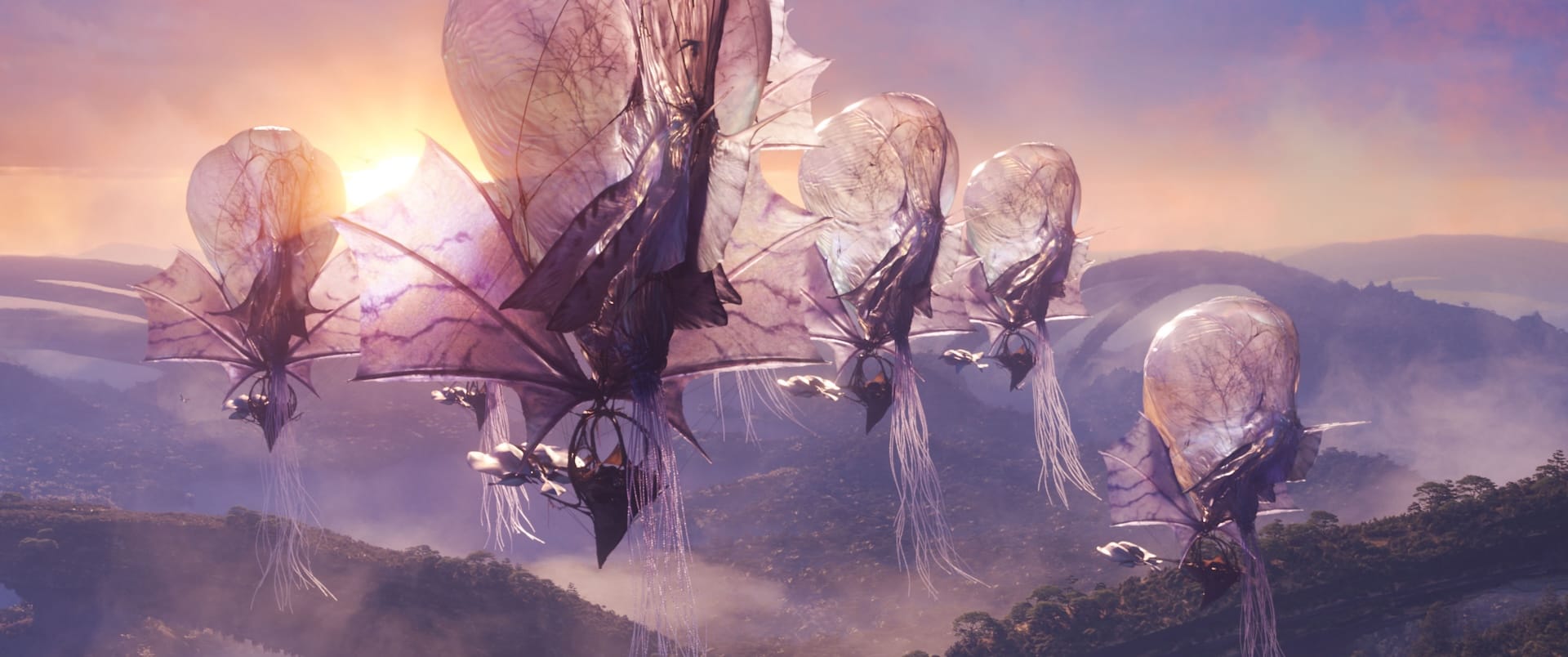
That disinterest in saying anything of substance is what continues to render Pandora mostly hollow. The film’s most interesting idea is how environmental tranquility can coexist with violence, and it concludes that it would be awesome if whales attacked ships. And true—it is awesome when that happens in real life, but for Cameron, it speaks more to him being an angry hippie who ultimately believes that communion with nature is a form of dominance. Going back to the first Avatar, when Jake tames an ikran, it’s meant to evoke taming a horse, but because the taming process works through the kuru, it looks like a form of sexual assault, where you have to penetrate to create a mental bond with the creature. That idea gets taken to a much larger scale in Fire and Ash, where Varang not only links with her victims before killing them, but also in the ways we see Pandora’s flora and fauna are turned to militaristic ends. For Cameron’s part, he wants the beauty of nature, but only if it retaliates violently. Using nature to defend nature makes the violence acceptable, even if it’s very weird to have a character shouting at a bunch of squid-shark creatures, “kill them all!”
As much as Cameron wants to make environmentalism the core of these movies, he can’t get there because it’s clear he loves the control of technology rather than the unpredictability of nature. There’s nothing natural in these movies despite their professed love for the natural world. That’s why they look so clean and shimmering, as if someone had polished a jungle. James Cameron loves nature, but only the nature with him as its god. Any true environmentalist would eschew technology that demands massive amounts of water to cool its servers, but Cameron sits on the board of Stability A.I. because technology, not nature, is his passion.
Fire and Ash can’t reconcile the contradiction here because Cameron has no interest in exploring difficult questions about how we co-exist with the natural world. Instead, he’s built a monument to the unnatural world, a digital frontier where he can place every leaf and direct every creature. What happens inside that frontier continues to be an afterthought, tired tropes and old story beats playing out not because they’re captivating, but because they’ll require the viewer to spend more time in Pandora. As Avatar: Fire and Ash unfolds, it doesn’t feel so much like Cameron is pushing the bounds of cinema because the medium no longer suits or interests him. He’s a narrative filmmaker because that’s what he knows, but Pandora remains a place that remains filled with everything but a worthwhile story.