‘Ballad of a Small Player’ Overplays a Weak Hand
The bluster and bombast of Edward Berger’s direction can’t overcome a cliché-ridden, silly script.


People unfamiliar with poker tend to overemphasize the importance of tells and bluffs. Those are the more theatrical elements of the game, and they’re not worthless, but the serious game is more about calculating odds and quiet patience. Poker may not be the game in Ballad of a Small Player (it’s Macao Baccarat), but the faulty logic still applies. Director Edward Berger believes that by mirroring the ostentatious elements of his protagonist, he’s livening up the plot, providing us with artifice that will eventually reveal something genuine. But Rowan Joffé’s adaptation of Lawrence Osborne’s novel is the same gambling drama we’ve seen before. It doesn’t matter that it’s anchored by another reliable Colin Farrell performance or a booming score from Volker Bertelmann. We know what gambling addiction looks like, and the only surprise here is how ridiculous the story gets in its desire to upend expectations.
Lord Doyle (Farrell) fancies himself a professional gambler, a winning hand away from changing his fortunes. He lives out of a suite in Macao, wears fine clothes, and even has the little yellow gloves as an affectation. This is all a thin veneer for a man who’s up to his eyeballs in debt and can’t win at baccarat despite the slim house odds. The citizens see him as a “wandering ghost,” or a “lost soul,” and he finds a kindred spirit in Dao Ming (Fala Chen), an employee at one of the casinos. The two forge a connection and perhaps a chance at mutual redemption, but Doyle can’t stop himself from going further in debt, and he’s also trying to outrun an investigator (Tilda Swinton) who knows about his shady past.
If Berger and Farrell have one major success here, it’s that they can depict Doyle as a scoundrel rather than a criminal. In this rendering, he’s not some debt-dodging gambling addict, but a poor, misguided man who strives to change his circumstances. The bright lights of Macao contrast nicely with his increasingly sweaty desperation, and Farrell is an expert at playing misguided men who nevertheless garner our sympathies. It’s a great performance, but it’s stuck in a movie where we know all of Doyle’s choices before he makes them, so there’s little room for the actor to keep us on our toes. Doyle is a man who prides himself on understanding the game, but still loses anyway, and the movie is too wedded to the tropes of the gambling picture to break out of this familiar loop.
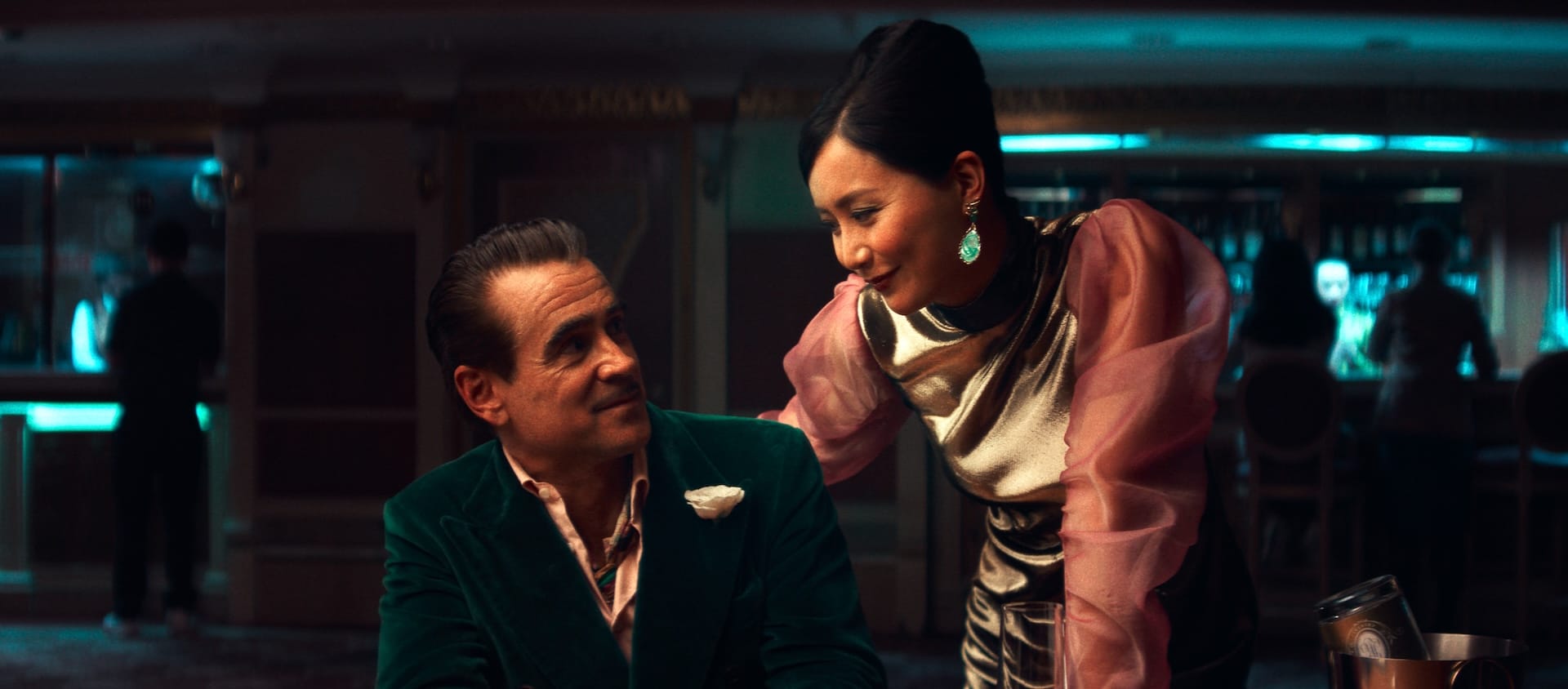
Where things get far worse is with Dao Ming. Chen does her best to play the quiet sadness of the character and find chemistry with Farrell, but the movie has no use for her as a person. It’s not interested in her interiority beyond some hollow exposition, and the more it leans on her, the more it shows she only exists to serve Doyle’s redemption arc. It’s one thing to place a white actor among a largely Chinese cast and say, “This man is an outsider and treated as such,” but that perspective crumbles as the movie needs him to “win.” Questions of culture and society become window dressing to this one English huckster and his emotional growth.
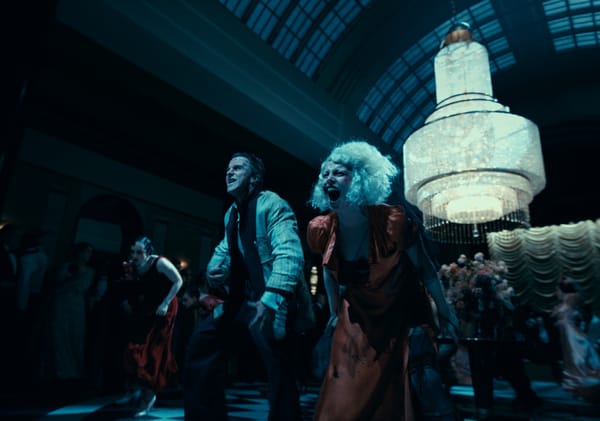
The film falls apart completely in its third act as it's too afraid to truly embrace the darkness at the core of Doyle’s character. There’s a fascinating idea that what harms the gambler isn’t losing but winning. Like a drug addict given a bottomless supply of their chosen narcotic, winning will only lead to further losses for Doyle. Unfortunately, the film has no subtlety, so we not only get a parable about a gambler who dies and goes to a hell where he only wins, but another story about the afterlife where gamblers have giant gaping mouths and tiny necks, symbolizing their bottomless appetites, and then Doyle starts catching reflections of himself where he’s become this monstrosity. It would be one thing if the film dared to truly damn Doyle, but instead, it makes the worst choice imaginable.
[I’m going to go into spoilers, so skip ahead if you’re bent on watching Ballad of a Small Player]
In what’s meant to be a shocking reveal, even though you can spot it from a mile away, Dao Ming is a ghost in the film’s second half. It’s not surprising because while Doyle is busy trying to eat himself to death, she appears out of nowhere to take him to a secluded home on the docks and helps him recover. In the film’s mythology, she is an active phenomenon, helping him finally win and get out of debt through her ghost powers, but it feels like a cheap win. Moreover, all the time Doyle and “Dao” spent connecting at her home was him just talking to himself. There’s something particularly gross about how an imagined woman is more beneficial to a guy than a real one.
[Okay, end spoilers]
There are good movies about gambling addicts (California Split comes to mind), but Ballad of a Small Player had little to add to the genre. While the movie is good at capturing the phony posturing of its title character, it does little more than accentuate his colorful attributes, always relishing the fancy visuals and aggressive music over any worthwhile narrative decision. It’s a bluff of a picture that thinks it can win audiences over through flash and phony uplift. But no one is a winner here. We just walk away, poorer for the experience.
Ballad of a Small Player is now playing in select theaters and arrives on Netflix on October 29th.