David Zaslav Got to Play Dress Up. It Cost Thousands of Jobs and Billions of Dollars.
As his tenure comes to an end, the former head of Warner Bros. Discovery showed he was ill-equipped to lead a media conglomerate.

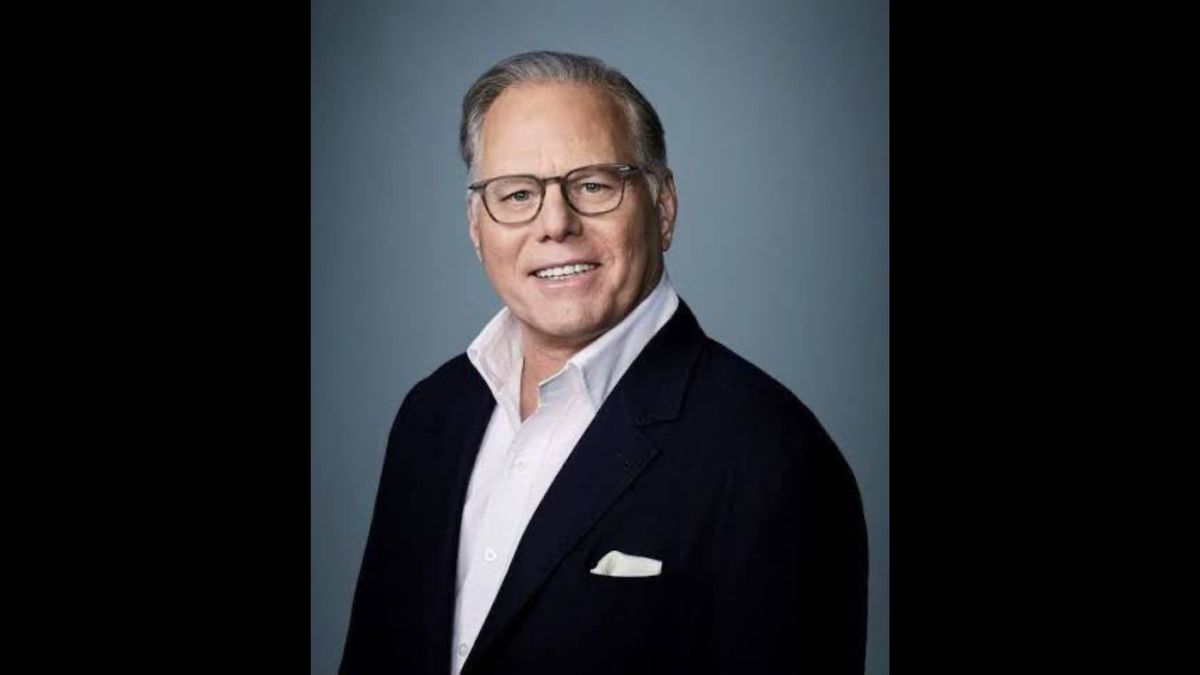
The kindest thing Hollywood and the media will do in the wake of Paramount merging with Warner Bros. Discovery and becoming Skydance is to forget about David Zaslav. They’ll look at David Ellison, the one with all the power and with an outsized control over what the world sees and hears, and blow past the guy who held Warner Bros. Discovery as a potential competitor to Netflix, only to fail spectacularly in the four years and change that he ran the company. While AT&T was also not a sensible owner, Zaslav proved himself to be the bigger fool, taking on $44 billion of debt for a corporation that was doomed before it even started.
On paper, there was some sense behind the merger. Zaslav, who ran Discovery, had a lot of reality TV assets. Warner Bros. had a bunch of scripted assets. Put them together, put them under a streaming banner, and you have something that could challenge Netflix in the streaming wars. Except, in April 2022, the month the deal closed, Netflix posted its first-ever dip in subscribers. At that point, Wall Street decided they needed a new metric for gauging success, and having the most subscribers didn’t matter as much anymore. Zaslav built a company to compete on a basis that no longer existed, and without the ability to ride the coattails of mentor John Malone as he had for most of his career, Zaslav floundered.
Not that it mattered much in the short term. Profiles from 2022 paint Zaslav as happy as a clam to be hobnobbing with celebrities who previously wouldn’t give the guy behind 17 and Counting and Dr. Pimple Popper the time of day. He purchased the old mansion of The Godfather producer Robert Evans. He sat behind the old desk of WB co-founder Jack Warner. He signaled to the town that he was an entertainment mogul, and as long as that job didn’t involve actually making entertainment, he was set.
Instead, while Zaslav couldn’t get enough of the trappings of the industry, he blundered constantly at doing the job. He chose to take tax write-offs on movies he didn’t think would be hits, resigning them to a vault or destruction, a short-sighted move that signaled his indifference to the creative efforts of others. Despite needing scripted entertainment to succeed in making a competitor to Netflix, the massive debt required him to nix almost all scripted shows coming out of the T-Nets (TBS, TNT, etc.). He didn’t have the money to re-up the lucrative NBA on TNT contract, instead letting the NBA slip to competitors like ESPN, NBC, and Amazon. Even victories like the success of the Harry Potter video game could be equally met by the massive flop of something like The Suicide Squad game. Hiring Chris Licht to run CNN only created more headaches. Cutting Cartoon Network only let competitors seize younger audiences. Maybe he would have been more focused on better work if he wasn’t whining to GQ to take down an unflattering editorial.
If movies were Zaslav’s bailiwick, he only managed to avoid his own incompetence through luck. Yes, he made the wise decision to hire Pamela Abdy and Michael De Luca to run Warner Bros. Pictures, but openly considered replacing them in 2025 before they went on a spectacular run of $40+ million openings, including the year’s biggest hits like Sinners, Weapons, and One Battle After Another. Furthermore, for a position that is supposed to owe his allegiance to the shareholders, he couldn’t close a deal on a Barbie sequel because he was too cheap to back the pre-production costs of bringing back key talent. As buyers like Netflix and eventually Paramount came closer to gobbling up his company, he likely shrugged and didn’t care if the rights lapsed back to Mattel in December (Ellison, with the former head of Mattel as Skydance’s new co-CEO, will likely have Barbie 2 moving forward before the end of the year). In Zaslav’s world, it was always someone else’s problem.
Perhaps the biggest example of his taste versus what the market wanted was his choice to greenlight The Alto Knights versus axing Coyote vs. Acme. The Alto Knights came from a Nicholas Pileggi script that had been floating around for decades, but Zaslav decided to do his buddy a solid, bringing on Barry Levinson to direct and get Robert De Niro to star in dual roles. The movie grossed a measly $10.2 million worldwide off a budget of $45 million. Meanwhile, Coyote vs. Acme, which the company sold to Ketchup Entertainment for $50 million, has pulled in $96 million worldwide, and will likely continue to make more through licensing deals as it floats between streamers like HBO Max.
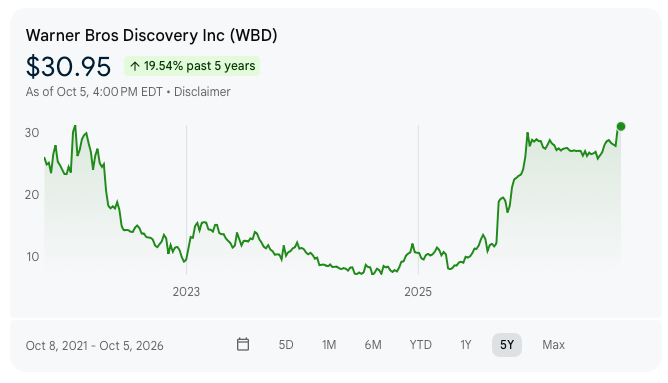
And what came from all this maneuvering? Well, you see that big trough below in the WBD stock price for the last five years? That’s David Zaslav.
But these mergers always promise to create jobs. How did that go? WBD had roughly 37,500 employees in 2022, and now it has 35,000, a loss of two thousand jobs to appease Wall Street, but did no such thing.
I was one of those thousands let go, so yes, I have sour grapes over this. I, along with other people at Turner Classic Movies, lost my job not because of careful consideration, but because Zaslav and his C-suite carelessly wanted to cut headcount. People who had worked at the company for decades were summarily dismissed. I lost my dream job, and for the past few years, it’s galled me because, not to brag, but I think I was pretty good at my job. I loved the work I did at TCM, and I loved the people I worked with, and we managed to create a crown jewel in the company for not a lot of money (thanks, carriage fees!). But I guess my dream doesn’t matter as much as someone who drove down the company’s fortunes and will now leave, making Hollywood even smaller and with less opportunity than before.
Zaslav’s actions will be a chapter in Hollywood’s decline. That story isn’t over, and perhaps the industry can rise again after being battered for almost a decade through mergers, COVID, strikes, and fires. But perhaps what would be most fitting for Zaslav is to resign him to the anonymity he deserves. He bought a storied studio, destroyed chunks of it, and now leaves to count his millions. At least his phone won’t be ringing off the hook with celebrities pretending like they want to hang out with him.