
‘Die My Love’ and the Motherhood Loneliness Epidemic
It takes a village and there is no more village.

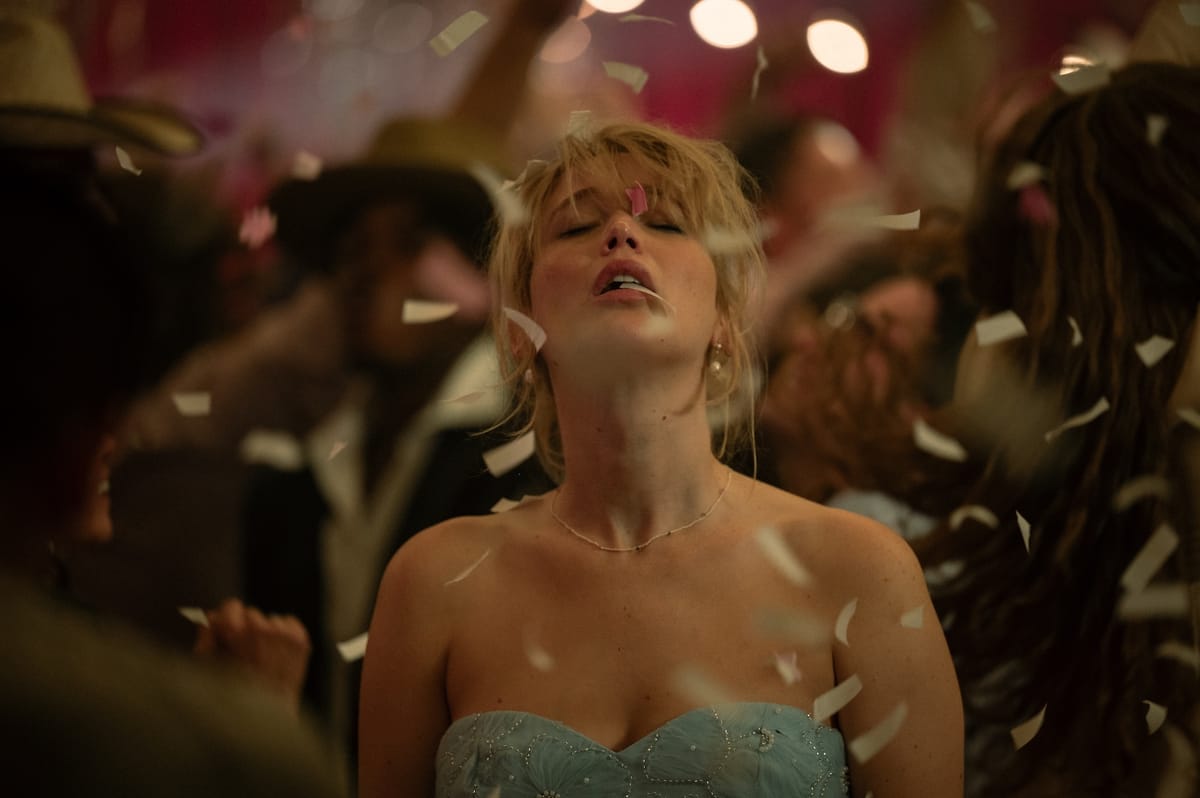
It’s a little perplexing for me to see op-eds wringing their hands about “the male loneliness epidemic” as if young men behind their computers are the only lonely people in the world. Of course, this all comes back to whose feelings we choose to center in American society, and wouldn’t you know it, some men are sad and are therefore entitled to relationships. Meanwhile, mothers, especially new mothers, are drowning. Motherhood has never been easy, but as our society grows more fragmented and we’re left with a feeling of permanent isolation and alienation created by social media and exacerbated by the pandemic, a recent spate of movies serves as primal screams of motherhood, asking for just a little bit of help rather than losing all sense of identity and control. We’ve seen it in films like Tully, Nightbitch, If I Had Legs, I’d Kick You, and now Lynne Ramsay’s Die My Love. These films emphasize that motherhood isn’t just difficult, but that it creates a mental fracture where you lose sense of reality and no one—not society, not your community, and certainly not your husband—is going to help you.
Die My Love shows how quickly liberation can become isolation. Grace (Jennifer Lawrence) and her boyfriend Jackson (Robert Pattinson) move to a run-down house in the middle of Montana so he can be closer to his ailing parents, Harry (Nick Nolte), who’s suffering from dementia, and Pam (Sissy Spacek), who’s trying her best, but has a habit of sleepwalking with a shotgun. Jackson gets Grace pregnant, and she gives birth to their son. She spends all day at home while he’s out most of the day at work. While Grace is a writer, she has no time for anything personal and feels the grind of loneliness in the middle of nowhere. She has no energy to be friendly, and even if she did, there’s no one to be friends with. Her sanity quickly starts to unravel, and while she loves her son, she also throws herself through a glass door just to feel anything.
Much like the symbolic fire that flashes in the movie’s opening minutes, Die My Love is not a slow burn. It ignites quickly into Grace’s downward spiral, and from there, it really has no place to go. Like other Ramsay movies, Die My Love leans into the horror and surreality of mental illness and forces the viewer to hold on tight. Furthermore, perhaps more than Ramsay’s other movies, Die My Love is not particularly interested in its characters as individuals as much as a collection of raw emotions. We have a brief sense of who Grace was before having a child, but that quickly evaporates in the onslaught of stress and madness that becomes her new identity.
On the one hand, this allows Lawrence plenty of room to really go for it as a performer, crawling around on all fours, spewing beer, and playing a range of exposed nerves. On the other hand, because Grace is more of a concept than a person, it feels like Lawrence is doing a series of acting exercises, exploring the space and letting loose without anything to really contain the scene or character beyond “Grace has absolutely lost it.” We understand that Grace is adrift and no one can help her, but it also gives the movie and the actors little space to build or expand on its core idea. Even its most horrifying ideas, like Grace seeing a glimpse of her future by witnessing the sad lives of Jackson’s parents, arrive in the film’s first half-hour.

The film works better when you set it alongside its contemporaries and how they’re speaking to our current moment. I don’t think any of the filmmakers behind these movies would argue that motherhood has ever been easy, but something has changed, and it’s not simply that women are more vocal about parenting hardships than previous generations. It’s that they’re seeing fewer opportunities, more burdens, and fewer support systems. Consider that motherhood demands a societal transformation where you no longer get to be “you” in the sense you once were. Not only have you physically changed, but the societal expectations immediately go to an uncomplaining nurturer. Die My Love and its fellow movies don’t inherently reject the child, but they do reject the framework that says you have to become a different person and you must do it on your own.
What’s particularly telling in these stories is how the husband figure isn’t actively abusive or malevolent, but he’s instantly disconnected. He doesn’t see child-rearing as a real job; he comes home and places more burdens on a weary mother and frequently criticizes her for not being a good enough mother every time she shows a shred of weakness. If you can’t rely on the person who says they love you in times of greatest need, what hope is there of depending on people outside the household? What community even exists anymore? We have no universal pre-K or daycare, and paying for those things is a massive economic toll on a family that only stresses them further.
Is it any surprise that the mothers in these movies tend to go a little primal? There’s something to envy in the animal kingdom where mothers have power and the tribe defends its own. No mother gorilla is sent to the supermarket and told to figure it out, and if she’s having a rough day and gets side-eye from the other mother gorillas. Social media isn't telling her all the ways she’s failing because she didn’t cook the perfect supper while the baby was running a temperature. If we’re evolved and supposedly in an advanced society, then why do we have a living nightmare for a sizable portion of the population? Does the propagation of the species depend on mothers going insane? That can’t be right.
Die My Love may not be the best among these movies, but it does feel the most immediate. It’s unambiguous in depicting the emotional torment of not only post-partum depression, but also that in creating life, there is also the death of hope. Grace can’t put on the rictus smile of other moms. She can’t suffer silently as she is expected to do. You’re supposed to take your baby and lose everything—self, community, desire—and somehow find happiness in only one thing and one task. It’s an insane ask, and Die My Love has no problem showing the resulting madness.
Die My Love is now playing in theaters.