‘Hamnet’ Is an Emotional Powerhouse. Does It Do More Than Make Us Weep?
Once you finish drying your eyes, Chloé Zhao’s drama requires some unraveling.

[Spoilers ahead for Hamnet.]
William Shakespeare had a son named Hamnet who died at a young age. Afterwards, he wrote Hamlet, one of the greatest works of literature in human history. Chloé Zhao’s Hamnet works to find its way between these events, remythologizing the Bard while also making him secondary to his wife, Agnes. There’s a lot in Hamnet that goes straight for the heartstrings, specifically the loss of children. Although it’s one thing to intellectually understand that families centuries ago tended to have more children because mortality rates among infants and toddlers were so high, Hamnet makes the pain of such loss feel real and immediate, no less than what we’d see from parents today. And yet Zhao and co-writer Maggie O’Farrell (adapting her 2020 novel of the same name) are telling us this story because it’s Shakespeare. Because we know that one name, and at times he overshadows the story while at others he is its channel, the way we can try to understand those who never achieved his fame yet felt the same pain, if not more so.
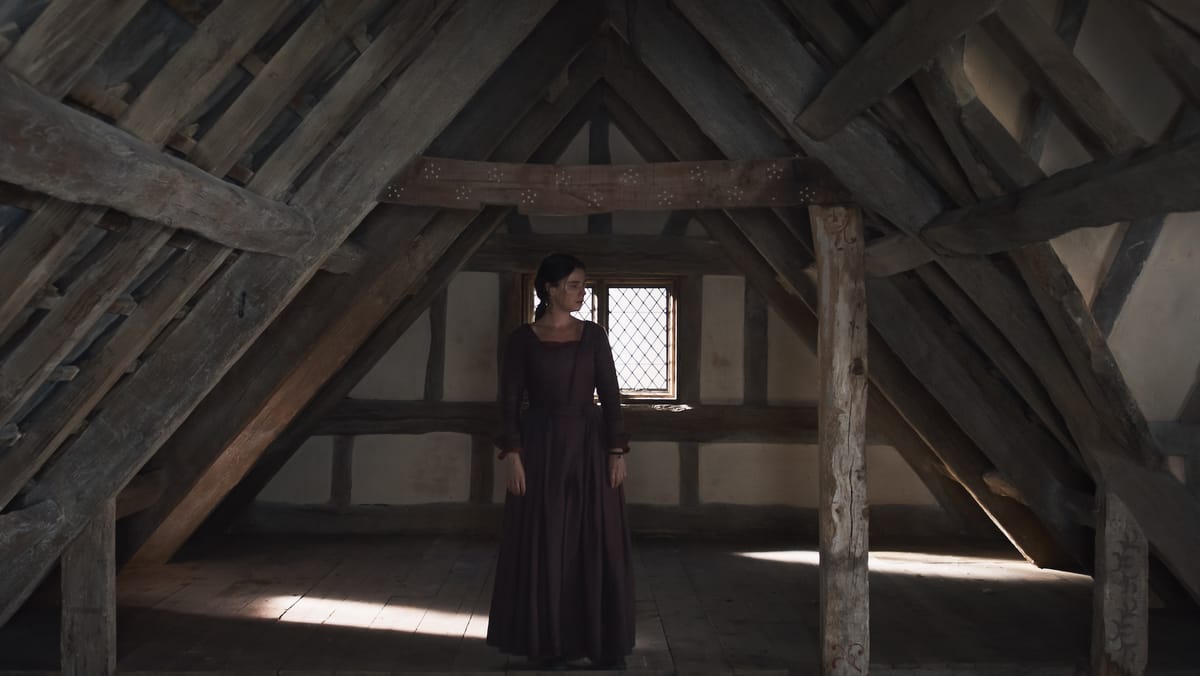
Trying to untangle this web of the ordinary from the extraordinary is Hamnet’s most daunting task. The story is largely from the point of view of Agnes (Jessie Buckley), not William (Paul Mescal), who isn’t even named as “William Shakespeare” until over three-quarters of the way through the movie, despite the audience understanding that’s the character. Such obfuscation is the contradiction Hamnet tries to hold onto throughout its runtime. You know William Shakespeare as a great writer, but you don’t know him as a loving husband or son of an abusive father. This is not Shakespeare in Love, where you’re really getting a cheeky Hollywood story wrapped in a charming period romance. That movie is always leaning into the greatness of Shakespeare juxtaposed against modern desires. Hamnet aims for universal emotions juxtaposed against why we even know the name “Hamnet Shakespeare.”
Part of what makes this all kind of wobbly is the move from the second to the third act. After Hamnet (played with remarkable skill by Jacobi Jupe) dies from the plague at the end of the second act, the film leans hard into being a marriage drama of sorts where Agnes resents Will for not being at home when their son died, and he’s struggling to express the extent of his grief and guilt. Agnes emotionally shuts down, unable to even look at Will, and Will starts devising Hamlet as an expression of his grief, even going so far as to compose “To be or not to be,” as he considers suicide in London. With the play’s arrival, Zhao appears to ask, “Who truly authored this staggering work?” Is it solely Will’s artistic expression? Does the forest, from whence Agnes says the women in the family in their family derive their magic, now exist on the stage?
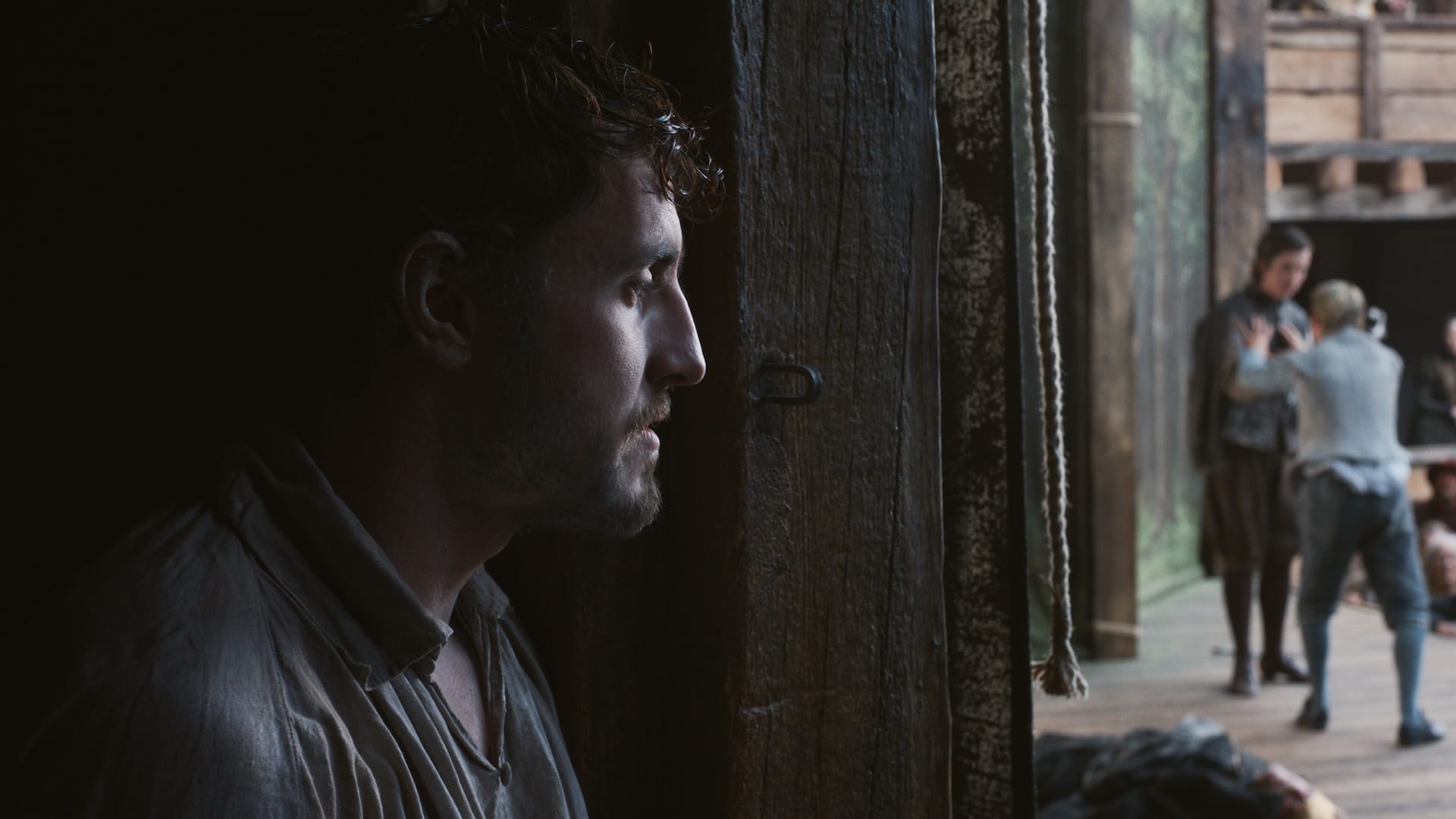
Moreover, the third act moves from Agnes’ expressions and viewpoint to Will’s. Agnes, a healer who couldn’t heal her son, now feels angry and trapped, but her husband, a storyteller, knows a way to express that grief, and that expression “frees” Hamnet’s soul, which is depicted as isolated and behind a veil after his death. It can only move on after the play’s culmination. However, with Will engaging in the act of creation, he becomes the active character, which transfers the dramatic power away from Agnes, who is so grief-stricken that she’s reduced to yelling at the stage while other patrons attempt to shush her. The story emphasizes her frustrations and limitations while allowing Will to transform, playing the role of the Ghost of Hamlet’s father and expressing his emotions in lines like “Adieu, adieu, adieu. Remember me,” in Act I, Scene 5. Agnes’ catharsis comes not from her actions, but from Will’s expression of guilt and sadness.
Within this framework, I worry that the emotional impact outweighs the thematic depth, as it’s possible Hamnet amounts to nothing more than secular homily. Agnes doesn’t believe in the afterlife, and Zhao frequently returns to a dark void in the forest to symbolize the nothingness that comes after death. In this framing, the way Hamnet “lives” is through the art and memory of his parents. It almost functions as a counterweight to Zhao’s last movie, the flawed yet fascinating Marvel Studios blockbuster Eternals, where creation comes from cosmic gods. In Hamnet, lasting creation comes from ordinary people experiencing a grief that’s both common for their time and yet no less specific and aching.
And yet, isn’t this just Star Trek’s “He’s really not dead, as long as we remember him?” Is there a deeper question beneath the emotional wallop Zhao lands, or is she simply trying to recreate the anguish that these two people must have felt, and how relatable it remains, just as we still connect to Hamlet? While no rule says there must be an appropriate ratio of subtext to suffering, the emotions in Hamnet, particularly from Buckley and Mescal, can feel so raw and overwhelming that we’re left wondering if there’s anything beneath the rending of garments and primal screams.
Perhaps these contradictions are meant to smash into each other, echoing the line from As You Like It that “All the world’s a stage, and all the men and women merely players.” Zhao frequently swaps back and forth between naturalistic, handheld cinematography and static shots meant to highlight characters within their interiors as if in a play. Visually, this is meant to culminate in the natural world (Agnes), now forest scenery in the Globe Theater (Will), a blended world they created in memory of their son. It’s not a bad approach, but it also feels like a way to try and keep Will and Agnes thematically connected even as the narrative pushes them apart, with Will working in London while Agnes stays in the countryside with the children.
I suppose it’s to the film’s benefit that I’m still turning it over in my mind days later, thus proving it’s more than just a weepie built to make our tear ducts work overtime. But for a movie that could be headed to a Best Picture win given its positive buzz on the festival circuit (it won the Audience Award at TIFF, all but guaranteeing it a Best Picture nomination), I continue to remain torn over how well the film works beyond its emotional wavelength. I certainly wouldn’t call the film cloying or overbearing, but I keep wondering if there’s something more here than a painful loss followed by a famous play.
Hamnet opens in limited release on November 26th.