In ‘House of the Dragon,’ the Futility Is the Point
The ‘Game of Thrones’ prequel series finally found a distinct identity in its third season.

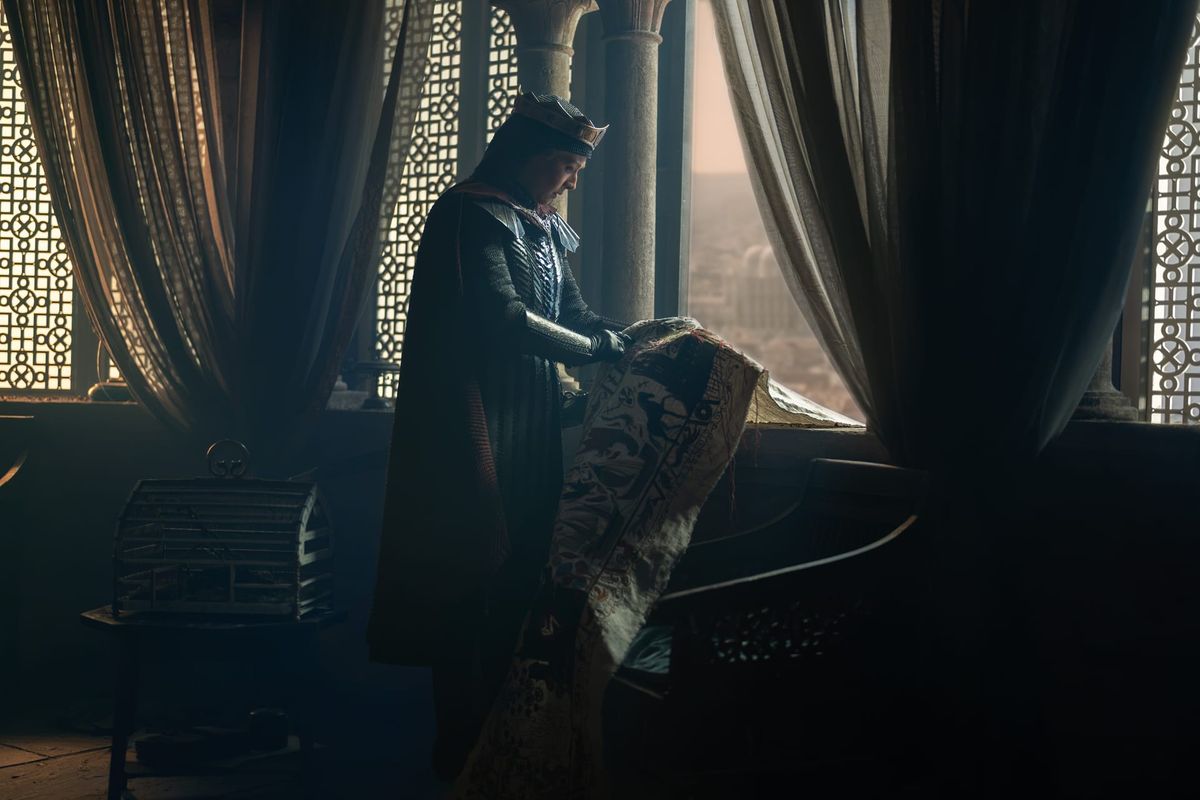
As House of the Dragon geared up for its third season, I admit that returning to the show felt more like an obligation rather than something I was excited for. The first season, which sped through the decades to set up the war between Rhaenyra’s “Blacks” and the Hightowers’ “Greens,” stumbled badly in its second season, going nowhere fast (likely due to the writers’ strike, where the show kept filming but had long stretches of inertia like Damon sitting around Harrenhal having weird chats with Alys). Thankfully, Season 3 functioned almost as a reboot of sorts, starting with a bang with the Battle of the Gullet and then placing Rhaenyra on the Iron Throne where she, like Aegon II, rules poorly.
There are weaker versions of this story where we’re locked in a battle of “Who cares?” since both leaders are bad, they lack vision for the realm, and they’re spoiled little whiners. What made House of the Dragon come alive is showing how the futility of their actions is the point; that what they imagine they want is a childish dream, but the suffering they inflict to achieve their goal is all too real. I seriously doubt that when the show launched in 2022, creators Ryan Condal and George R.R. Martin thought it would be relevant that a miserable, disloyal, blond brat would be back in power and fruitlessly leaning on the strength of arms that gets them nothing, but hey, sometimes timeliness comes to you.
As a prequel series, House of the Dragon faced an uphill battle, not only in how it drew comparisons to Game of Thrones, but because as a prequel, the outcome is ordained. Even if you haven’t read the books, we know this show takes place a couple hundred years before Game of Thrones, and that show begins with neither a Targaryen nor a Hightower on the Iron Throne, but a Baratheon who married a Lannister. Rather than deflating the stakes, House of the Dragon realized they should use that endpoint to their advantage. In the first season of Game of Thrones, Cersei famously said, “In the Game of Thrones, you either win, or you die.” House of the Dragon replies, “What if there is no victory, but only death?”
The Season 3 finale hits that point hard with the Battle of Tumbleton, a major conflict that we’ve been leading up to all season, and it only highlights how neither side “deserves” to win, nor have any theory of even a simple conquest. Both sides hinge their plans on Ulf the White, but neither even knows where he is (it turns out he’s passed out in a privy). Rhaenyra thinks there might be some way to both conquer a town, kill enemy soldiers, and keep the citizenry intact and loyal, and she’s a fool. Her arc this season shows her getting what she wants—ruling the realm—only to demonstrate that she’s no good at it. Her mercy is fickle, her loyalty is non-existent, and her grievances are petty.
This can all make for a tough watch if you believe that you need someone to “root” for, but thankfully, the writers understand that it’s more important to keep characters compelling rather than uplifting. The show realized who it needed to clear off the board like Criston Cole and Jacaerys Velaryon; then it let strong performances shine from Tom Glynn-Carney, Abubakar Salim, Clinton Liberty, Tom Bennett, Gayle Rankin, James Norton, and Tommy Flanagan. Even an actor like Dan Fogler seemed brought on board so he could fire off a good comic line. Rather than leaning on the forward momentum of “What happens next?” House of the Dragon embraced the color of its characters and, for the most part, diminished the characters who weren’t working.
That’s a difficult dramatic tension to maintain where you care about the characters more than the outcome, but Season 3 largely managed to strike that balance. Not every scene was perfect (I could have done without almost any scene featuring Mysaria), and not every episode had nonstop momentum, but at least it felt like the board was shifting in ways that illustrated how those who felt like they were born to rule had no place on the Iron Throne. Even Aegon, who came into his own this season despite being half-dead and out for revenge, managed to grow and change in compelling ways. The show threaded the needle of not necessarily arguing that he earned the right to be king, but also that he wasn’t the same spoiled child who felt entitled to rule. Granted, such arguments lacked subtlety (Larys straight-up tells Aegon he was a lousy man, a lousy king, and deserved to be half-cooked in a battle to which he was not invited), but at least they were delivered by exciting performers.
Finally stepping out of Game of Thrones’ shadow, House of the Dragon feels set for a strong conclusion when it returns for its final season (likely in summer 2028 if it stays on schedule with previous seasons). The show won’t drag out forever or tee up some long-heralded arrival like the White Walkers. If anything, the series feels liberated from such buildup as it found its footing in chaos and decline. Like its fellow prequel series, the excellent A Knight of the Seven Kingdoms, the trick has been not in epic plot machinations as much as it’s been a return to what made Game of Thrones an exciting show in the first place—two people talking in a room. By focusing less on changing a Westeros that will move far beyond these figures, and instead leaning into the idea that no one, whether through their own actions or larger forces, gets what they want, House of the Dragon came alive by showcasing thwarted ambition and the collateral damage.
Want to support this newsletter, but don't want a paid subscription at this time? Consider making a one-time donation.