‘Mercy’: Sit in Judgment of This Vapid Sci-Fi Chamber Piece
Chris Pratt runs up against the limitations of his acting ability in this demo reel for Timur Bekmambetov’s screenlife silliness.


Some actors are so good that they can hold your attention with their stillness, conveying complex emotions with a glance. Chris Pratt is not one of those actors. If anything, what makes Pratt a charismatic star is that he knows how to go broad and animated, which is why he’s found such success as both a comic hero and voice actor. But as I’ve remarked before, Pratt keeps trying to frame himself as a tough guy; someone who projects strength and tenacity as if that’s what his chiseled physique demands. To his credit, his latest film, Mercy, is an attempt to see what he can do if you take away the movement and force him to sit in a chair. Could he hold the screen with limited movement? Sadly, the answer is “not, really.” Trapped in a story packed with silly, artificial constraints, Pratt grimaces and makes his eyes water in an empty narrative that still asks him to play the hero as countless VFX graphics dance around him.
Detective Chris Raven (Pratt) awakens in a chair on trial in the newly formed “Mercy” court. Raven is accused of murdering his wife, Nicole (Annabelle Wallis), but he got blackout drunk the night before and has no memory of the event. In the Mercy court, you have 90 minutes to prove your innocence to A.I. Judge Maddox (Rebecca Ferguson). You’re allowed access to any and all evidence instantaneously (including people’s bank records!) in an attempt to prove your innocence. Using his connections and skills as a detective, Raven attempts to piece together whether he’s truly guilty or if someone else is to blame.
Arguably, the most interesting thing about Mercy is that, despite its sci-fi set-up, the movie has no point of view. Director Timur Bekmambetov and screenwriter Marco van Belle take the idea of a surveillance state fed into A.I., trying to prove innocence to a computer, and have nothing to say about the society that would foster such a system. The film’s intro all but says that Mercy is a kangaroo court, a way for the powerful to quickly remove undesirables from crime-infested streets of Los Angeles, but then the rest of the movie treats Mercy in good faith. It’s like the filmmakers watched Paul Verhoeven’s RoboCop and thought, “I like what this OCP is up to, and we really should start rolling out more ED-209s.” The underlying fascism and mockery of the trial system don’t interest Bekmambetov; everything Maddox does is to further along the whodunnit.
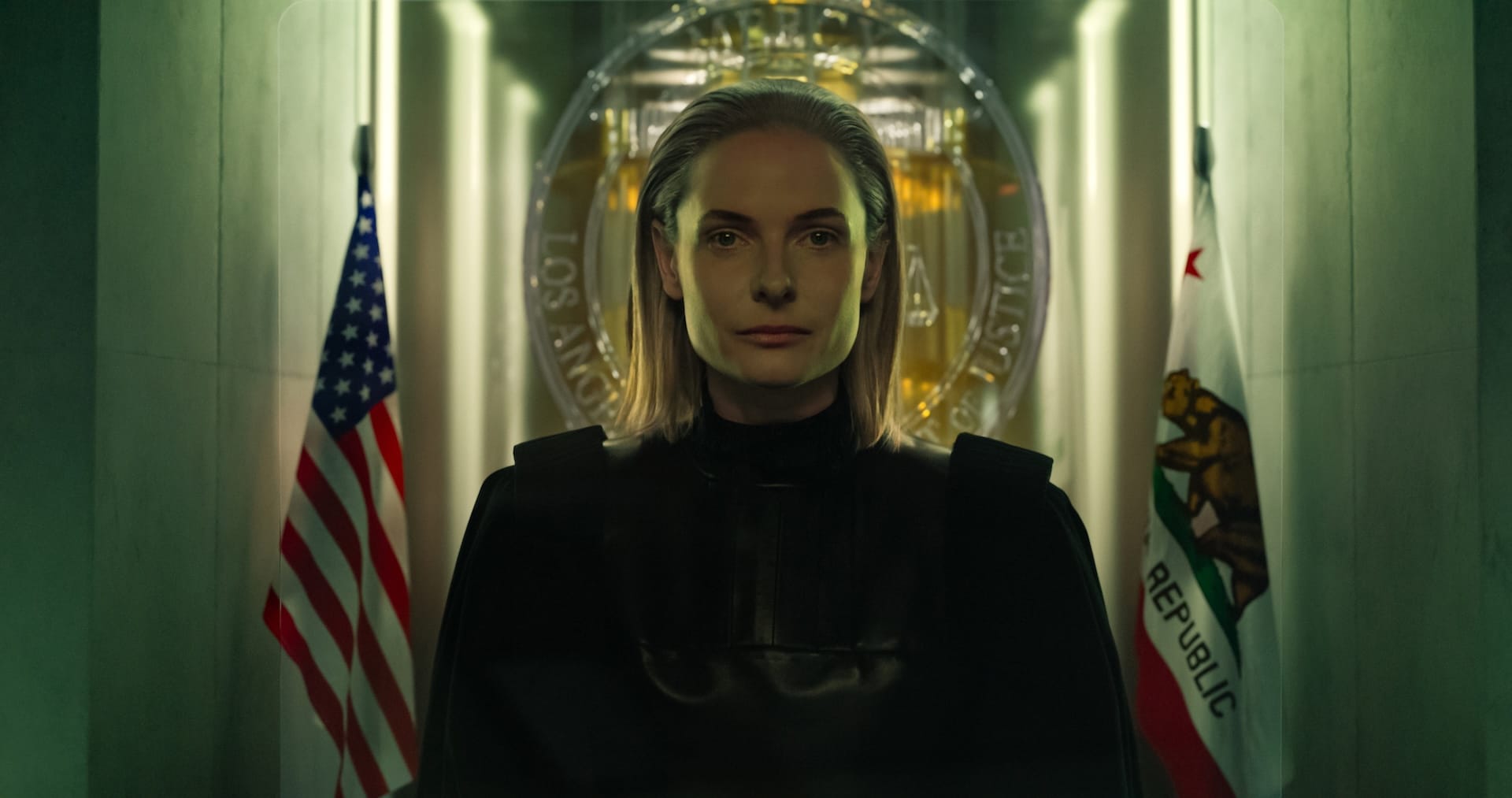
Watching Raven wrestle in the chair is a real “Reaping, Sowing” moment that the character never considers because he always has to play the game (and Mercy, with its deluge of graphics and icons, frequently feels like watching someone playing a video game). Because the film has no point of view, it never sees Mercy as a perversion of justice or considers the role Raven played in sending people to their deaths. It’s all a belabored way of putting Raven in the hot seat and watching him piece together evidence to find the culprit.
Solving the mystery becomes even less interesting with Pratt at the center. While Raven leans darker than a typical Pratt character, as he’s an alcoholic cop who has blown up his family life through his bouts of rage, the movie skips over his darkest element, which is his initial support of the Mercy court. Instead, most of Pratt’s performance is him emoting to the rafters, afraid that the camera, despite being in close-up, will miss his weepy eyes or angry grimaces. Watching Mercy, I thought back to 2013’s Locke, another chamber piece where a character has to sit in a single location and hold the movie through their conversations with others. But Chris Pratt is no Tom Hardy, and Bekmambetov has no problem with his lead actor playing every emotion as big as possible.
Instead, he seeks to match Pratt’s intensity with all the dumb screenlife stuff around him. “Screenlife,” for those who don’t know, is Bekmambetov’s movement to integrate the screens we use into dramatic narrative. Sometimes this works like in the 2018 thriller Searching, and sometimes you get last year’s widely-derided War of the Worlds. I suppose experimentally, there’s something interesting about all the ways digital technology has intertwined with our lives, and working to find a way to express that. But as you can see in Mercy, Bekmambetov doesn’t care about the social and cultural implications of pervasive surveillance technology; he simply sees it as fodder for more visuals to crowd the screen and have them whoosh by Raven (literally “whooshing” as these holographs move by him, blowing his hair back, which means there must be little fans in the Mercy court to simulate wind).
Neither Bekmambetov nor Pratt seems interested in any emotional stakes for this story. When Raven calls people, no one seems bothered that this friend or loved one is going to be executed in less than 90 minutes. They’re just information delivery systems. As the audience, we don’t care because even if Raven is innocent, he never wrestles with his culpability in supporting the Mercy court in the first place. The movie doesn’t even seem bothered that Mercy still has much to learn about humanity, as if the previous 18 people it executed were unfortunate beta testers. Again, with a Verhoeven-esque sense of dark humor, you could have had a fun way of skewering the intersection of tech and militarized policing. But that would require a director who cared about more than his graphical doodads and an actor with greater range than Pratt can provide at this point in his career.
Mercy opens in theaters on Friday, January 23rd.
What I'm Watching
David Ehrlich dropped his annual Top 25 video this week, so be sure to check that out. Additionally, as a gesture of support, please consider donating to Ehrlich's chosen charity, the Palestine Children's Relief Fund.
What I'm Reading
I'm about two-thirds of the way through Wuthering Heights, which I'm reading before Emerald Fennell's new adaptation arrives on February 13th. I have some strong thoughts on the novel, but I'll keep them to myself until I finish the book, which I expect to do by the end of the week. After that, I'll return to my year-long Vonnegut project, which continues with The Sirens of Titan.
Online, I recommend this latest article from Jamelle Bouie, which flatly states we're in Mad King Territory with Trump. Others, especially news analysts, keep trying to rearrange Trump's rhetoric and actions into something sensible, and I respect that Bouie can call out what we're all seeing: The President is not well, and that is extremely dangerous for the entire world.
I also really liked this article from Brian Phillips over at The Ringer, which looks at the dystopian aspect of gambling apps like Kalshi and Polymarket, where users can bet on anything. I'll probably have more to say in a future newsletter about how this moment feels like living in a casino, but for now, definitely check out this piece that explains why these apps are so terrible.
What I'm Hearing
I finally finished listening to Karina Longworth's season of You Must Remember This on Polly Platt, and it's one of the best biographies I've ever come across. The foundation of the season was Platt's unfinished memoir, but Longworth's journalism allowed her to bring in other voices and provide a complete, sympathetic, but unflinching portrait of a woman who was instrumental to some of the greatest films of the 60s, 70s, 80s, and 90s. I've listened to a lot of You Must Remember This, and I think "Polly Platt: The Invisible Woman" may be the best work Longworth has ever done.
I'm also listening to 99% Invisible's The Power Broker Breakdown, which is easier to do now that I'm not in the middle of reading the book and feeling like I have to wed my progress to their new episodes. Co-hosts Roman Mars and Elliott Kalan have terrific insights, and they've also had fantastic guests. My favorite so far has been Alexandria Ocasio-Cortez, who provides unique insights into how the corridors of power work and the tricky balances you have to strike between personalities and policies.
What I'm Playing
I keep meaning to start Ghost of Yōtei, but I can't pull myself away from the soothing rhythm of the PowerWash Simulator games. I've finally started up PowerWash Simulator 2, and it's provided the perfect getaway from the stress of social media. Rather than doomscrolling on my phone, I just pick up my PlayStation Portal, pop on a podcast, and clean things. It's very nice.