Not in IMAX
Not every movie is built for spectacle. Not every movie should be.
Movies used to be everything. During the era’s golden age in the 1930s and 40s, there was no competition for mass visual entertainment, and so you could conceivably spend your entire day in a theater where your purchase would net you a newsreel, a cartoon, a short, and a double feature. Television took a bite out of all of this, and it used an ad-supported model to siphon away shorter-form programming. Starting in the 1950s, Hollywood attempted to woo back moviegoers with bigger pictures. They introduced widescreen formats, 3D, and other, more questionable gimmicks to lure back audiences. Some of these changes, notably the wider aspect ratio, remained, while others faded or resurfaced with the promise of changing moviegoing forever.
Hollywood is facing similar shocks today with the success of not only streaming, but user-produced videos across YouTube, TikTok, and Instagram. The industry’s most successful response has been on IMAX, which carries with it a heftier ticket price, but unquestionably gives audiences an experience they can’t replicate at home or on their phones. IMAX is built for spectacle, and major studios now jockey for roughly 1,700 screens worldwide1. If you have a major blockbuster coming out, you want the IMAX screens, and you also want to tell audiences that your movie was filmed for IMAX, meaning it wasn’t converted in post-production but shot with IMAX cameras.2
This has the added effect of making IMAX movies into “events.” A terrific video by director Ryan Coogler explained different film types and why his latest movie, Sinners, changed aspect ratios for certain parts of its IMAX screenings.
Christopher Nolan, who has made himself practically synonymous with IMAX since The Dark Knight in 2008, has been one of the format’s greatest evangelists and used it to help power his movies to box office behemoths. Oppenheimer, an R-rated biopic, made almost a billion dollars worldwide, and Universal started selling tickets to his next movie, The Odyssey, one year in advance (albeit only for 70mm IMAX screenings).
The big problem here is that not every movie can be an event or in IMAX. You can’t have “Barbenheimer” every weekend, and not every movie is built for spectacle. This month, we’re getting a reminder of why that’s okay and how a healthy theatrical slate requires more than event pictures.
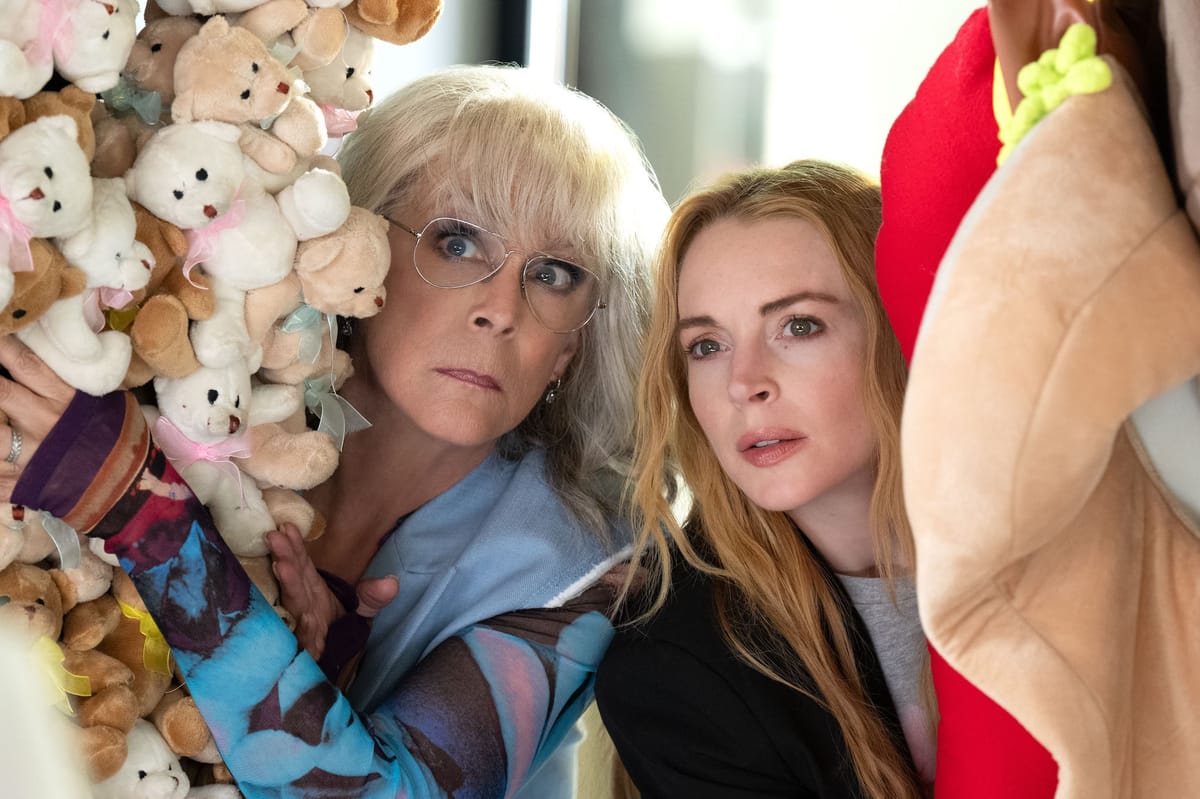
Last weekend, we got The Naked Gun, which aspired to be nothing more than the goofiest comedy possible. That kind of movie used to regularly populate theaters, and has, like most comedies, slowly vanished to make way for either blockbusters or artier fare (I hesitate to say “indies” because films from NEON and A24 are still being made in a studio system; they’re just doing it at a lower price point). This weekend, we’ll get Freakier Friday, a family comedy that’s not an animated feature. On the one hand, these are both legacyquels, but on the other hand, their original iterations weren’t total originals either (2003’s Freaky Friday was a remake of the 1976 movie of the same name, and the 1988 Naked Gun was a continuation of the TV series Police Squad!).
Neither one of these movies is an “event” made for IMAX, but they’re still good movies, and audiences need this diversity. Streaming offers the illusion of massive choice, but it’s a watered-down, forgettable product that’s meant to fill an algorithmic role rather than something that people talk about and enjoy. You may get something like Netflix’s KPop Demon Hunters, which manages to capture the zeitgeist, but more often than not, you’ll get The Pickup, which would have flopped outright in theaters, but on Prime Video exists because Amazon MGM doesn’t own the rights to any of Eddie Murphy’s good action-comedies. Theatrical is a vote of confidence where, even if the movie may not be good, the studio believes in it enough to market it and have the box office results be public.
Furthermore, these movies aren’t trying to explode or reinvent their genres. The Naked Gun is proudly a spoof. Freakier Friday is proudly a family comedy. There’s no question of where they stand. Compare that to The Fantastic Four: First Steps, and I’m sure Marvel would highlight how it’s a family comedy because the Fantastic Four are Marvel’s “First Family,” and there are jokes. But we all know what the scale of a family comedy is, and those intimate stakes can get lost when you’re fighting a cosmic god who eats planets. Marvel trades in spectacle, but by trying to be all things to all people, they only highlight the limitations of the superhero genre.
If theaters are going to survive streaming’s onslaught, studios will need to right-size their development slates. That doesn’t mean abandoning blockbusters, but it does mean finding ways to make movies for more modest amounts and more modest returns. It also means truly competing with streamers beyond the size of the spectacle or trying to turn every release into an event. It means reacclimating audiences to the idea that theaters can have something for everyone rather than a single big movie that attempts to be all things to all people.
Most of these are not genuine IMAX but digital retrofits. For example, here in Georgia, the Regal Mall of Georgia has a true IMAX screen, but Regal Atlantic Station does not; most audiences don’t seem to care since the company has used this “IMAX Experience” branding for well over a decade now. ↩
Even here, the terminology can be fuzzy. Avengers: Infinity War was the first movie shot entirely with IMAX digital cameras, but Christopher Nolan’s upcoming The Odyssey will be the first film shot entirely with IMAX film cameras. The challenge with the latter has been that the film cameras have been cumbersome and noisy, so their use has been limited until technological advancements allowed filmmakers like Nolan greater freedom of movement and not drowning out the on-set dialogue. ↩