‘Roofman’: A Soft-Focus Look at the Collapse of the American Dream
Derek Cianfrance’s latest runs into the limits of likability.

A recurring mistake that some moviegoers and more than a few studio execs make is that protagonists must be “likable.” They can be flawed, but ultimately, we must “root” for them. Although there are occasional anti-heroes that sneak through, audiences tend to resist main characters who behave despicably and unapologetically. Derek Cianfrance’s new movie, Roofman, opens with an apology as its main character, Jeffrey Manchester (Channing Tatum), explains in voiceover that he’s not a bad guy; he just did some bad things and made some bad choices. But the film’s eagerness to put us on Jeffrey’s side misses a lot of the fallout of his decisions, opting repeatedly to emphasize his charm and charisma rather than the deception and manipulation he relied upon to pursue his vision of the American Dream. While Cianfrance has previously told stories of morally fallen fathers, Roofman strains to absolve and sympathize with a bad dad who can see ten steps ahead for a robbery but can’t grasp how his actions may harm those he claims to love.
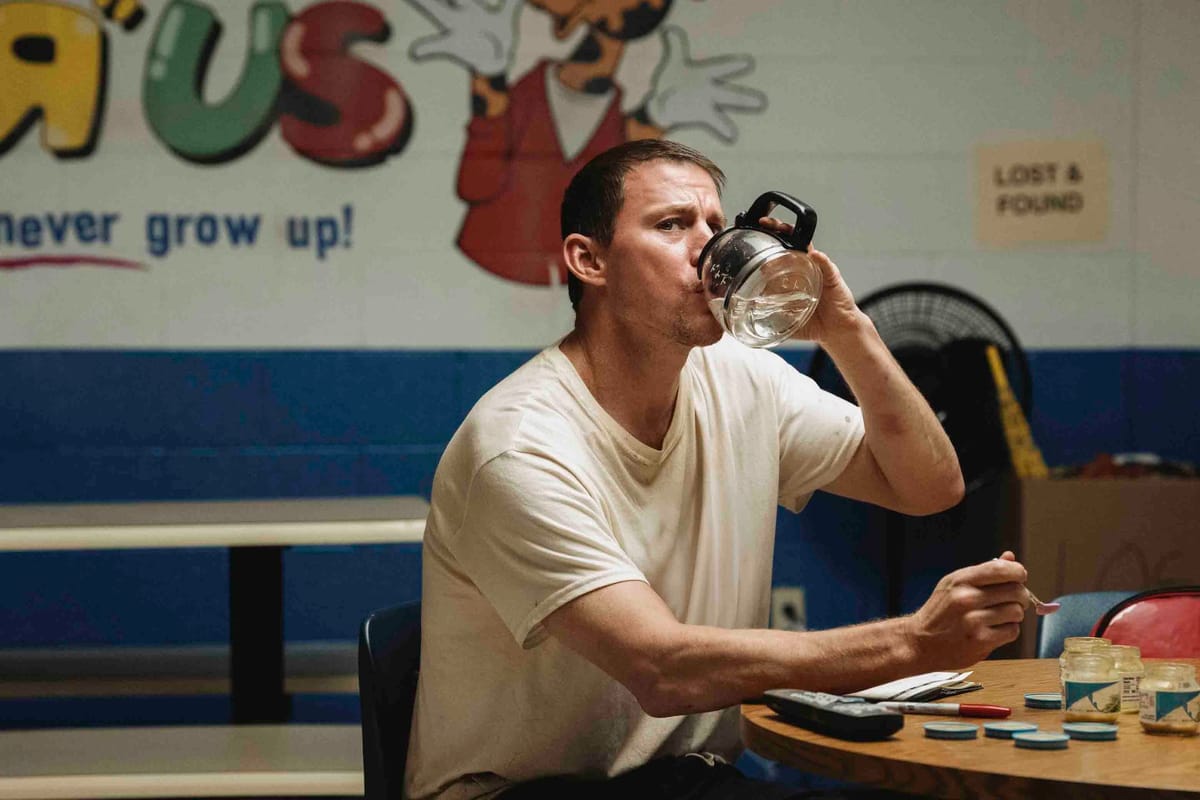
Jeffrey Manchester has a very specific set of skills. He can clock the weak points in any system and infiltrate them, which made him a great soldier, but apparently doesn’t translate to any other position (the film’s “out” for Jeffrey lacking a real job is that he’s the smartest dumb guy you’ll ever meet). When getting his adorable daughter an Erector set for her birthday instead of the bicycle she wanted registers a look of disappointment on her wide-eyed face, Jeffrey resolves to start robbing McDonald's to get his daughter a better life. After he’s apprehended a year later at her more expensive birthday party, he’s sentenced to 45 years in jail. However, imprisonment is a small inconvenience to Jeffrey’s intellect, so he escapes and starts living inside a local Toys R Us. When donating a bunch of stolen toys to the local church, he meets Toys R Us employee Leigh (Kirsten Dunst), and he sees an opportunity for a new life with her and her kids under the assumed identity “John Zorin,” despite being an escaped convict.
For a director who has never shied away from darkness in his stories, Roofman feels like Cianfrance took every studio note here. Watching the film, I was reminded of his far superior 2012 movie The Place Beyond the Pines, which is another story of fathers committing criminal acts as they seek to provide for their families, but their sins always blow back on the people they claim to love. Roofman avoids these conflicted feelings, and always wants our sympathies to rest with Jeffrey as a well-meaning but misguided screw-up. We’re meant to admire his charm and intellect and not think too hard about the wreckage left in his wake. No one is meant to mourn the harm done to McDonald's or Toys R Us, but the movie is oddly indifferent about how he betrayed his family. When he calls them after his escape, his young daughter is laughing and playing with her mom’s new boyfriend, clearly unbothered by the time her dad was arrested in front of all her friends at her birthday party. The camera instead lingers on Jeffrey’s face, asking us to recognize how much he’s lost in his attempt to provide material comforts to his kids.

There’s an interesting idea at the center of Roofman about what it means to be a provider and how Jeffrey’s idealized vision of being a husband and father can only be realized through criminal means, but even here, the movie is oddly superficial. Not only does his relationship with Leigh and her kids feel like a repeat of his crimes from the prologue on a larger scale, but it sets financial problems as one of wants rather than needs. He’s not trying to pay for orthodontics or home repairs or anything that can take a serious financial toll on a family; he's buying video games and CDs and other items he thinks can purchase his way towards love. Again, that’s the seed of an interesting idea about being a good guy in a consumerist culture, but the film can only reach, “Jeffrey is misguided, and that’s kind of a shame.”
What’s even more perplexing is that Cianfrance has so many colors to work from here, and a terrific cast who are eager to tell this story. Both Tatum and Dunst are at the top of their game, adding wonderful shades of sorrow and longing to characters who are striving to create a nuclear family on working-class wages. Cianfrance fills out the cast with heavy hitters down to the most minor roles, with actors like LaKeith Stanfield, Juno Temple, Ben Mendelsohn, and Uzo Aduba helping to flesh out this world and provide a bit more dramatic and comic weight to the piece, even if their characters are thinly drawn. All this talent adds up to a movie that can be surprisingly funny and emotional, but always feels like the watered-down version of a stronger story.
Roofman should feel like it’s hitting at just the right time. We are in an affordability crisis, and the American Dream of upward economic mobility feels all but dead. Like Jeffrey, we’re surrounded by goods, but we’re not living as much as we’re trapped. And yet Roofman always wants to pull back to the softest rendering of this crisis, making its story about one flawed, colorful individual who was a nice man who did some bad things. Cianfrance has always found the humanity in his broken, desperate male characters, but here, he overshoots the mark, crafting more of an apologia for an individual than a harder look at what Jeffrey Manchester’s actions meant in a waning America.
My writing elsewhere:
· My review of TRON: Ares over at Decoding Everything.
· My review of The Woman in Cabin 10 over at TheWrap.