In the Unnerving ‘Rose of Nevada’, the Past Captures the Present
From its cinematography to its haunting premise, Mark Jenkin’s unique time-travel tale shows who gets sacrificed for the idea of a better world.

Part of the appeal of nostalgia is how it insists on returning to a time that never fully existed. Its nuances are lost, and all you can see are the outlines of what was. We see this clearly in economic decline, where booming hamlets are now ghost towns, built by prosperity that has receded into the mists. Writer-director Mark Jenkin cleverly turns this approach upside down with his patient and tense Rose of Nevada. Rather than tell a story of someone who chooses to go into the past, it is about who gets forced into that crucible and what they have to give up for the community. It is a movie about not only the death of the future, but a past so oppressive that it permeates every frame.
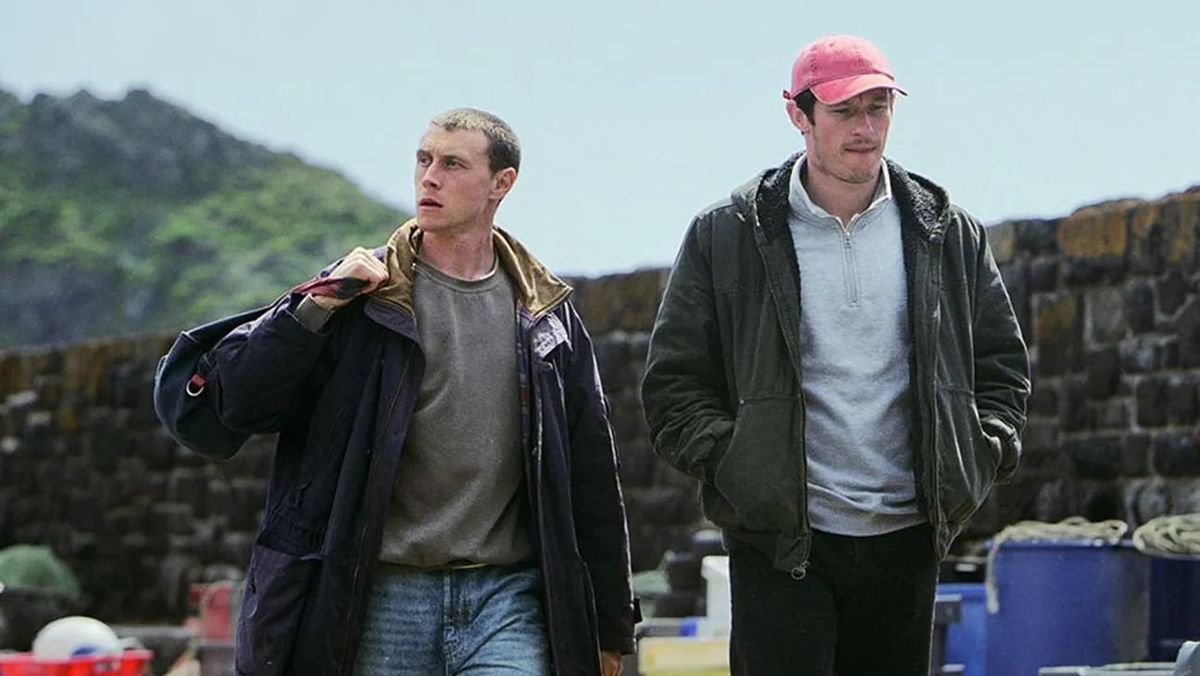
In an economically downtrodden Cornish village, the Rose of Nevada, a fishing trawler, mysteriously returns to the dock. Its owner, Mike (Edward Rowe), astonished at its return, confers with Tina (Rosalind Eleazar), a widow who lost her husband on the ship’s previous voyage, and they agree it should be crewed and sent out again. He hires Murgey (Francis Magee) as skipper, and two down-on-their-luck locals: Nick (George MacKay), a father and husband who needs money to fix a hole in his roof, and Liam (Callum Turner), a homeless drifter who needs the work. They leave to fish, but when they return, they’ve gone back in time over thirty years, and Nick and Liam are being mistaken for Luke and Alan, respectively, the two men who disappeared with the Rose of Nevada decades earlier.
Jenkin grabs us from the jump with his 16mm Bolex photography, which is what he used on his prior features Bait and Enys Men. Some may argue that for a film that transports its characters to the ‘90s, camcorder footage would be more appropriate if you’re going for a lo-res, out-of-time look. However, I would counter that not only does the 16mm footage simply look better, it’s also tactile in a way that fits the rural setting as well as making the whole picture feel off. It’s like we’ve stumbled upon old film canisters, and no one can explain where or how the footage got there. With his frequent close-ups on rust and decay, Jenkin makes the world come alive with minimal exposition. We feel the tension without needing to narratively grasp why we’re uneasy.
He also trusts his audience to be patient. The jump to the past doesn’t come until about halfway through the two-hour feature, and while there’s plenty of foreboding and mystery in the first half, he’s not trying to rush to time travel stuff. It’s a sci-fi film that has little interest in science and leans more on mysticism and the allure of the past. Liam, taking on the role of father and husband, sees no reason to come back to a life of nothingness. The pressure is on Nick to get back to his family, but there’s also the knowledge that as Luke, he represents a lost son to parents who were shattered by their child’s death.
The larger framework is why communities would seek to push their young men into the past. We see this here in the U.S., where people romanticize the coal industry. It’s brutally tough, it’s highly dangerous, and it is less prosperous for its workers with each passing year. We see it in communities where the factory shut down and went overseas, and so the past of steady work and thriving communities becomes a mental retreat. The people grieve the loss, and in their grief, they can only recreate the past rather than imagine what a different future could look like. Jenkin has the empathy to understand that this doesn’t make anyone particularly villainous as much as it makes them human.
The clever trade-off here is that in typical time travel stories, the individual chooses to go back in time to right a wrong. Here, Nick and Liam are tricked into service, giving up the lives they have in the present to be part of what the community seeks in the past. As with most time travel narratives, you can’t pull too much at the threads (if Nick and Liam are now Luke and Alan, does that create a paradox where Nick and Liam never existed and thus can’t choose to go on the boat in the first place?), but thematically, it’s a sharp stab at nostalgia without ever being vicious towards those who seek to return to the past. The film understands that retreating into the past also means sacrificing the future, and we feel that sacrifice through MacKay’s soulful performance.
Some may not be able to get on the film’s strange, ethereal wavelength. It’s unlike almost any other time travel movie, both in its cinematography and how it positions who has agency within the journey, but that makes Rose of Nevada one of the more surprising and rewarding entries into the genre. For those willing to get on board, they won’t soon forget the trip.
Rose of Nevada is now playing in limited release.
You can also check out my review for the live-action remake of Moana over on Decoding Everything:
 Matt Goldberg
Want to support this newsletter, but don't want a paid subscription at this time? Consider making a one-time donation.