'The Long Walk': A Brutal Journey through America's War Machine
Text, subtext, and taking genre stories seriously.
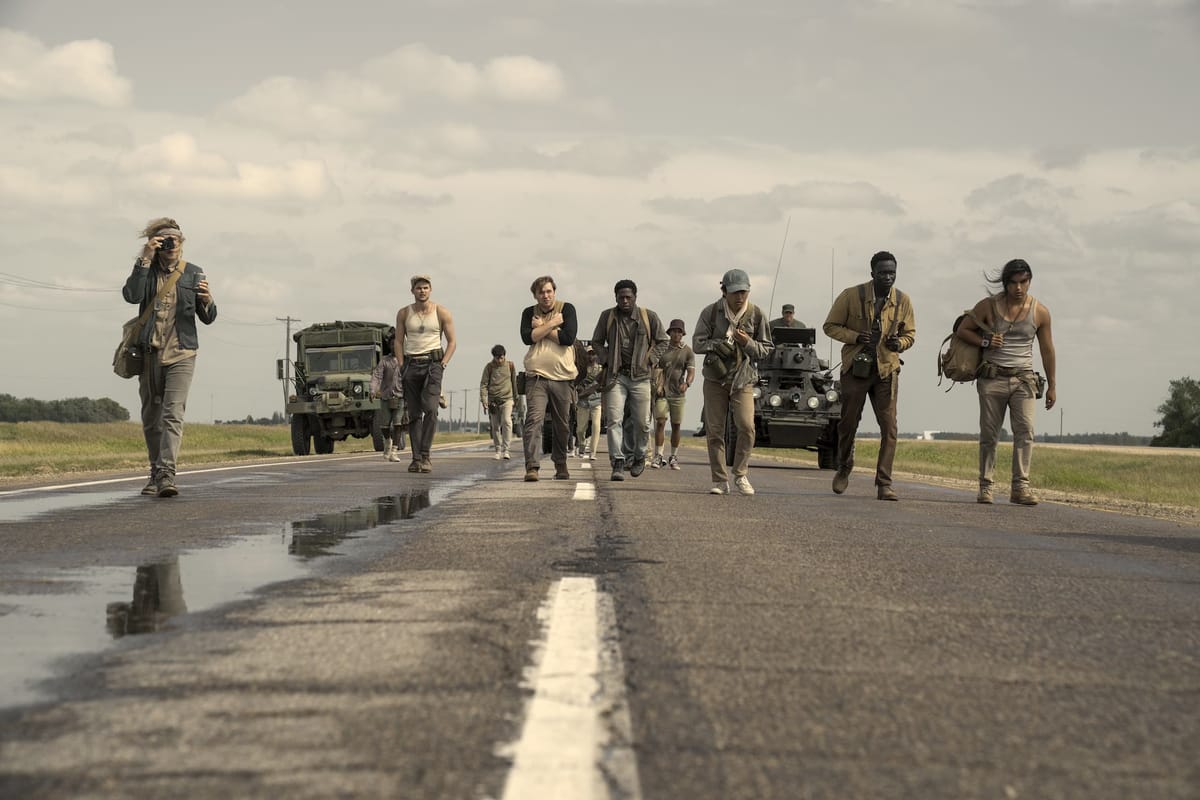
The Long Walk is an incredible film about the brutality of war, but it doesn’t involve any historical event. Adapted from the story by Stephen King, The Long Walk takes place in an alternate America. In this America, the country is on the other side of a devastating war and economic collapse. As a means of boosting the country’s morale and thus generating higher productivity, the government holds an annual event called “The Long Walk.” Participation is voluntary, and one man from every state is chosen to participate. The rules are simple: you must walk at least three miles per hour. If you stop walking or slow down, you’re given three warnings, and then the troops escorting you will shoot you in the head. The last man standing wins wealth and gets granted a wish.
This is a high-concept premise, and at first blush, it would seem in line with the previous movies of director Francis Lawrence, who directed all The Hunger Games movies except the first one. It also seems on par with the popular Netflix series Squid Game. Either way, it’s a dystopian existence where human suffering is built for entertainment, and no one really “wins” because the larger game is ultimately rigged.
But I would counter that Lawrence, quite consciously, is not working in the same mold as his Hunger Games movies or within the colorful shades of Squid Game. Although cameras follow the contestants of The Long Walk, the film has little interest in entertainment or spectator sport. Lawrence does away with anything that would signify a game show. The men show up in their own clothes, the clothes tend to be fairly drab (highlighting the poverty of the contestants), there’s no big send-off, and they walk almost entirely through rural areas. The Hunger Games and Squid Game are making a conscious point of how the arena is purposefully crafted for maximum entertainment value through bright colors, individual personalities, and kill-or-be-killed survivalism. In The Long Walk, contestants get a dog tag with an identifying number, and no one makes a move to kill anyone else since it’s too risky to slow down.
So if this is not about the intersection between bloodsport and capitalism, what is Lawrence doing here? As the film unfolds, it’s clear that Lawrence and screenwriter JT Mollner leaned heavily into the Vietnam War subtext of King’s novel, which he began writing in 1966-67 as a freshman at the University of Maine. In addition to the dog tag, nothing here is particularly subtle. As contestant Raymond Garraty (Cooper Hoffman) notes early on, “voluntary” participation is a joke since everyone is in such dire financial straits that The Long Walk never has to force anyone into playing (a la The Hunger Games). In the Vietnam era, soldiers were drawn primarily from working-class and poor backgrounds (you may have heard a song about that). Furthermore, all the participants are roughly the same age, mostly from their late teens to mid-twenties. Again, this is not a Hunger Games or Squid Game situation where players are drawn from all walks of life. Everything here is meant to evoke young men going off to war.
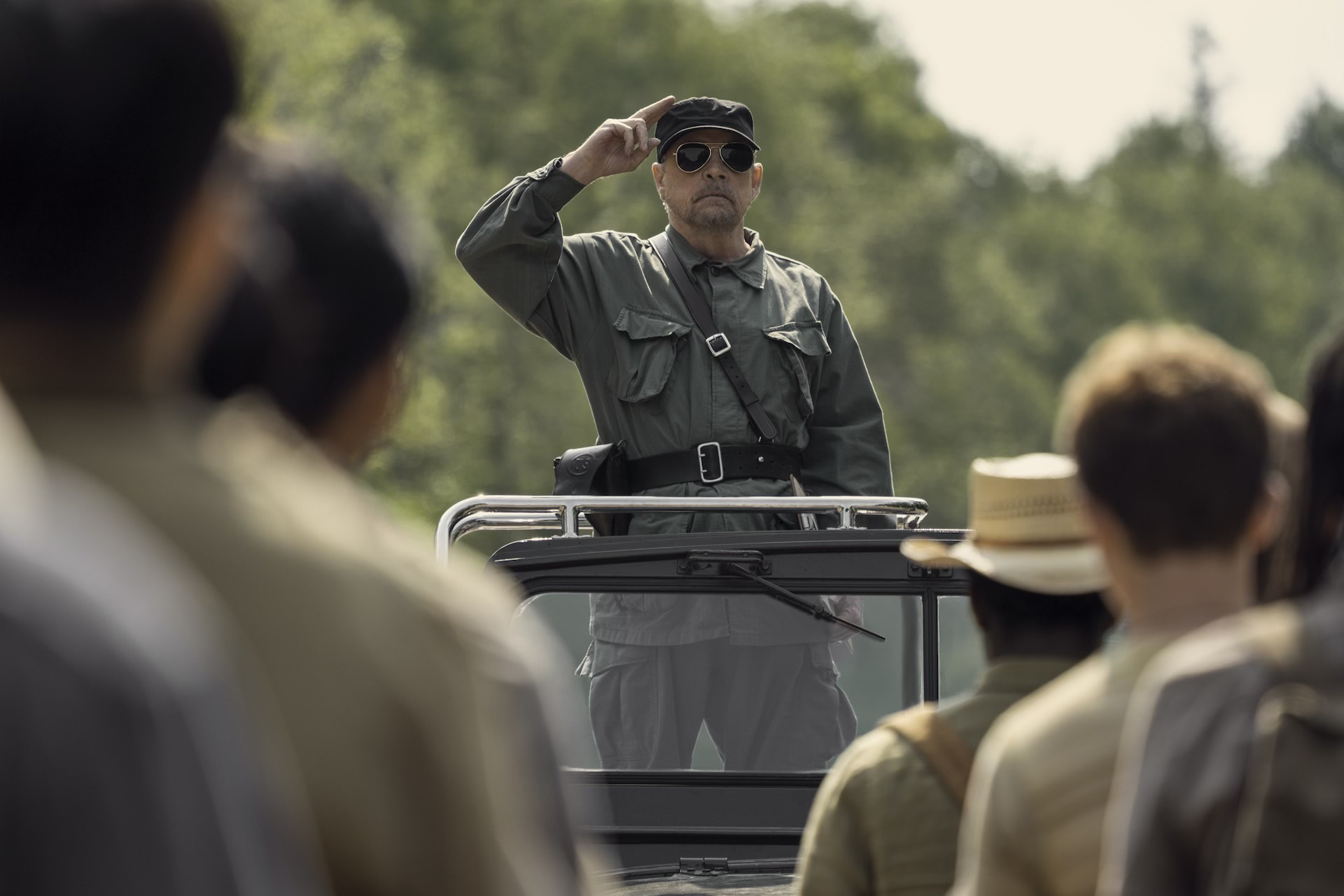
Why not just make a Vietnam War film? Setting aside that there are quite a few of those already, to make that movie elides the larger point King and the filmmakers seek to make, which is that the true enemy is the U.S. war machine, not some overseas adversary. The film’s personification of evil isn’t a foreign leader; it’s “The Major” (Mark Hamill), a man whose eyes are always obscured by dark aviators, and whose raspy voice is always barking out some jingoistic nonsense every other sentence. The Major is now a national icon, the “host” of the show, but immune to its consequences. He feeds the contestants pablum about glory as he comfortably rides ahead in a jeep. The Major promises comfort and adulation, but only if you survive on his arbitrary terms. Furthermore, to obtain such comfort, others have to lose.
These touches make The Long Walk biting satire, and one that’s far more concerned with how America chews up lives not for security or peace but for minor stability. The Long Walk hasn’t improved America’s fortunes, just as America didn’t come out of Vietnam as a stronger country. All it did was kill a bunch of young men as the country struggled to reclaim an imagined past glory. Although there’s certainly fascism in the dystopia of The Hunger Games, what we have here is far more in line with films like Joe Dante’s Homecoming and Paul Verhoeven’s Starship Troopers.
What makes this all particularly brutal is how Lawrence keeps letting the light through. The deaths of the men are hard to watch, especially as we grow to know them (comrades-in-arms dying for a multitude of reasons, but mainly bad luck), and yet Lawrence doesn’t plunge into this brutality as much as he seeks to contrast it against the beautiful landscape. The larger question hovering over this ordeal is, “Why do we create suffering in a beautiful country?” It’s not beautiful in its government or its deals, but the landscapes are truly stunning. The environment is beautiful and hints at national splendor. Instead, we soak it with blood.
The beauty of the countryside carries over to the bonds between the contestants, particularly Garraty and Peter McVreis (David Jonsson). While some contestants see their fellow walkers as competitors, the friendship that quickly forms between Garraty and McVries is the soul of the picture. Strangely similar to 2025’s other Stephen King adaptation, co-starring Mark Hamill, The Life of Chuck, there’s a life-affirming message beneath the horrors. Both films acknowledge that life is short, brutal, and unfair, and that all we can do is try to find moments of beauty in between the horrors. While The Life of Chuck takes its conclusion to uplift, The Long Walk reaches a bleaker ending about carving out what meager dignity you can in an unforgiving world.
These ideas and performances (Jonsson in particular gives one of the year’s best turns as McVries) make The Long Walk as potent as the best war films, but it must be relegated as a “thriller,” even though most of the movie is as steady as any drama, with the camera holding on young actors playing a scene. Although the complexion of war has changed in the decades since Vietnam, its larger costs remain cruel and constant. When we tell war stories, it’s not only about battlefields and soldiers. It’s not about being far from home. It’s about how much gets sacrificed for phony ideals. The Long Walk is fiction, but everything it expresses about America is painfully real.