
‘The Secret Agent’ and How All Things, Including Identity, Must Pass
Kleber Mendonça Filho’s drama is a sly look at life under authoritarianism.

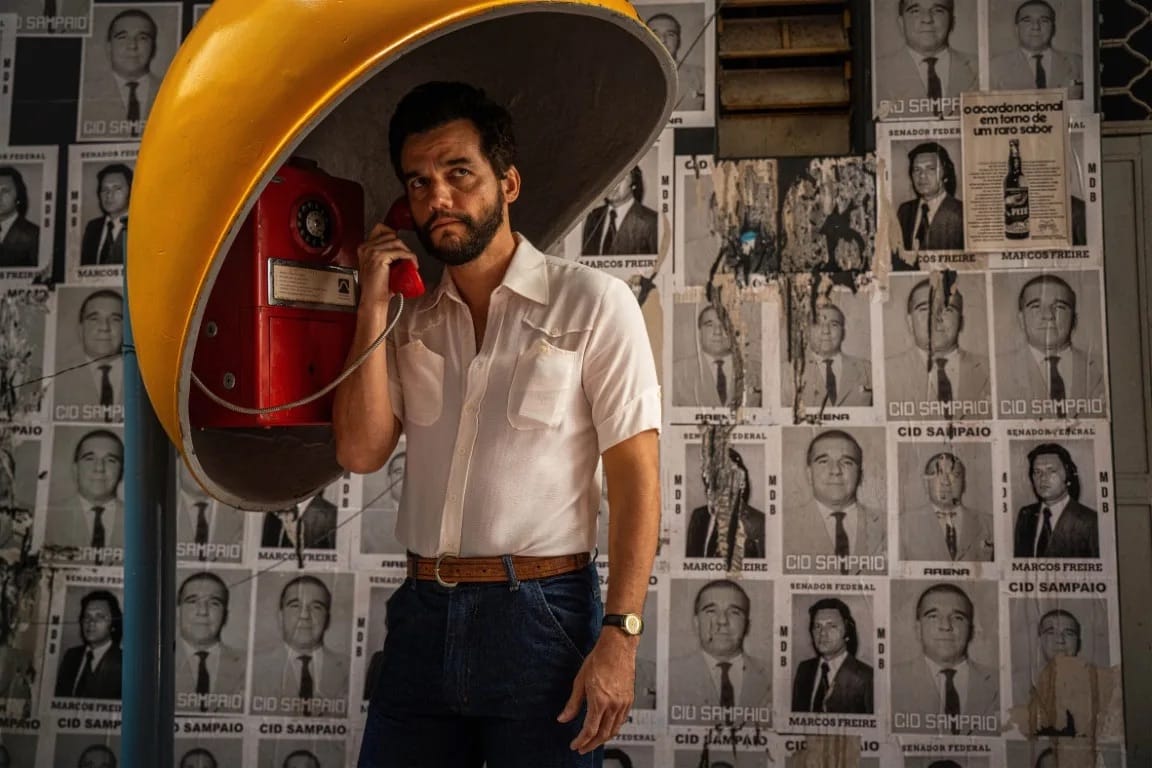
Earlier this year, I watched Apocalypse in the Tropics, a documentary on Netflix about the intersection between Christian conservatism and the rise of the right-wing in Brazil. It’s easy to see the similarities between Brazil’s trajectory and the United States’, except when Brazil’s aspiring authoritarian, Jair Bolsonaro, attempted to toss out the results of an election, the country held him accountable and sentenced him to over 27 years in prison. I suspect Brazilians were more likely to fight for democracy because they know what it is to lose it, as the country endured a military dictatorship between 1964 and 1985. For the modern viewer, we like to comfort ourselves that we can actively push out the darkness in our lifetimes, but as Kleber Mendonça Filho’s The Secret Agent, like last year’s Oscar-winning I’m Still Here, reminds us, not everyone makes it to the other side. What remains can easily be lost and buried, swept aside by the currents of time. Through a subtle and captivating performance from lead actor Wagner Moura, The Secret Agent ponders the thin line between transformation and obliteration.
Set in 1977, a man under the name “Marcelo” (Moura) arrives in Recife and lives among other political refugees. He wants to get back to his son, Fernando (Enzo Nunes), who is being raised by his grandfather Sr. Alexandre (Carlos Francisco), a projectionist at a local theater. As Marcelo, whose real name is Armando, attempts to lay low, we see the swirl of corruption and violence around him from the dirty chief of police Euclides (Robério Diógenes) to the hitmen sent after Armando by a former corporate titan. It’s a world of forced intrigue and secret meetings, and where reality itself can seem to fracture, like when a partially digested human leg found inside a shark comes back to life and starts attacking people in a public park at night.
The dark comedy of The Secret Agent sometimes has difficulty matching its somber tone, but it does work overall as Filho works to convey the slipperiness of the era, or as the prologue text says, “a time of great mischief.” There is some playfulness here, but the “mischief” refers more to a sense of chaos that easily tips over into mayhem. No one can be recognized for who they are because corruption has so thoroughly seeped into the body politic and culture. Like the leg found in the tiger shark’s stomach, we know this used to be part of a person, but it’s now mangled and decayed, a shadow of the human being now dead under the casual violence allowed under the regime.
What makes The Secret Agent powerful is that it’s not a plea for hope or even rebellion, but endurance. So much of our current discourse is geared towards effecting change, and we live in an on-demand world where we expect those changes to come quickly or not at all. Films like The Secret Agent and I’m Still Here are sharp reminders that change will come, but not everyone will get to see it. And yet, despite this bleakness, what makes these stories heroic is how our protagonists retain a sense of self as the world tries to twist and warp individuals towards nihilism and despair.

“Marcelo”/Armando is a terrific performance from Moura, not because it’s flashy or because he plays these identities so differently, but because he always taps into the mournful sadness of a man clinging to the last shreds of his decency and humanity. Armando gets targeted for assassination not because he’s some key player in a well-organized rebellion, but because he’s a former science professor who mouthed off to a violent oligarch. The trick of the performance is watching Armando try to move through the world with his dignity intact, using the violence and thuggery of the state against itself as he maneuvers to try and escape Brazil with Fernando. Similar to Bob Ferguson (Leonardo DiCaprio) in One Battle After Another, Armando is a man who sees authoritarian forces all around him, but he’s trying to resist the impulse to fall into despair for the sake of his child.
I will note that it does take a little while for The Secret Agent to finally emerge satisfyingly. The first half of the movie is steeped in so much subterfuge and tangents that we have trouble getting a grip on Armando, his actions, and, for those (like myself) who only understand the broad strokes of post-war Brazilian history, the world he inhabits. While I never felt confused or lost watching the movie, it purposefully leaves us in the dark and a little adrift as we work to get into the mindsets of the characters. A brief detour to expat Hans (Udo Kier) is a brief parable about how authoritarianism warps everything. The corrupt police chief and his goons mistake Hans for a Nazi fugitive rather than a Holocaust survivor. While it’s not surprising that Euclides knows nothing, the scene also illustrates that for Hans, he’s safer not correcting these loutish overlords. And yet, within the framework of the movie, you have to accept this as almost tangential since Hans and Armando’s stories connect thematically rather than narratively.
What the film leaves unanswered for those outside the casual corruption of authoritarianism is how you will live and identify yourself when your sense of self collides with the state? If you plead for decency in indecent times, will that end your existence, or does that mean planting an idea for those who will come later? The title “The Secret Agent” is itself a bit of somber irony, implying a rich cover. In actuality, Armando will typically shed his “Marcelo” name unless he’s in immediate danger. An identity built on lies, whether it’s for a nation or an individual, is one where toxicity spreads, and the battle for those who wish to live honestly becomes a matter of pragmatism. The Secret Agent doesn’t provide easy answers or homilies about life under authoritarianism, but it does seek to celebrate those who find a way to keep their souls intact, for however long they remain on this Earth.
The Secret Agent is now playing in theaters and will expand to around one hundred venues tomorrow, including the Plaza Theater.