'The Smashing Machine': Dwayne Johnson Is the Best at Losing
The actor's latest makes for a curious career pivot, but fails to probe deeper into the intersection between love and hostility.

In a time when traditional movie stars were growing scarce, Dwayne Johnson seemed like one of the few who could open a picture based on his name. He's had a curious career, not only rising through professional wrestling to become one of its icons, but going through phases in his film career that didn't immediately position him as a leading man. His big debut was essentially a plot point in The Mummy Returns, where he played the exposition only to become an unconvincing, roaring scorpion monster. This then led to The Scorpion King, and some more interesting decisions like playing supposed good guys who make heel turns (Get Smart, Doom) and then becoming franchise viagra by starring in the sequels Journey 2: The Mysterious Island, G.I. Joe: Retaliation, and Fast Five. This paid off as he started to open bigger movies, going from lower-budget thrillers like Snitch and Faster to blockbusters like San Andreas and Jumanji: Welcome to the Jungle.
As his stardom grew, Johnson sought to make himself a brand machine that could not only make big movies but sell small-batch tequila and change the hierarchy of the DC Universe. But stardom is fickle, and if you want that stuff to work, you need to make hits, or at least movies that people like, and he had some resounding thuds with Black Adam (a movie he had worked on for 15 years), Red Notice, and Red One, the last of which perhaps tarnished his image more than anything. Regardless of what you think of his movies, Johnson fostered an image of a dedicated, devoted worker who wanted to put forward the best movie possible. Now he was working only with a certain set of journeyman directors like Rawson Marshal Thurber and Jake Kasdan, and more damning, showing up hours late and peeing in bottles to make up the time he missed. The nicest way you can frame that is a guy who is stretched way too thin and lost sight of why people found him worth rooting for in the first place.
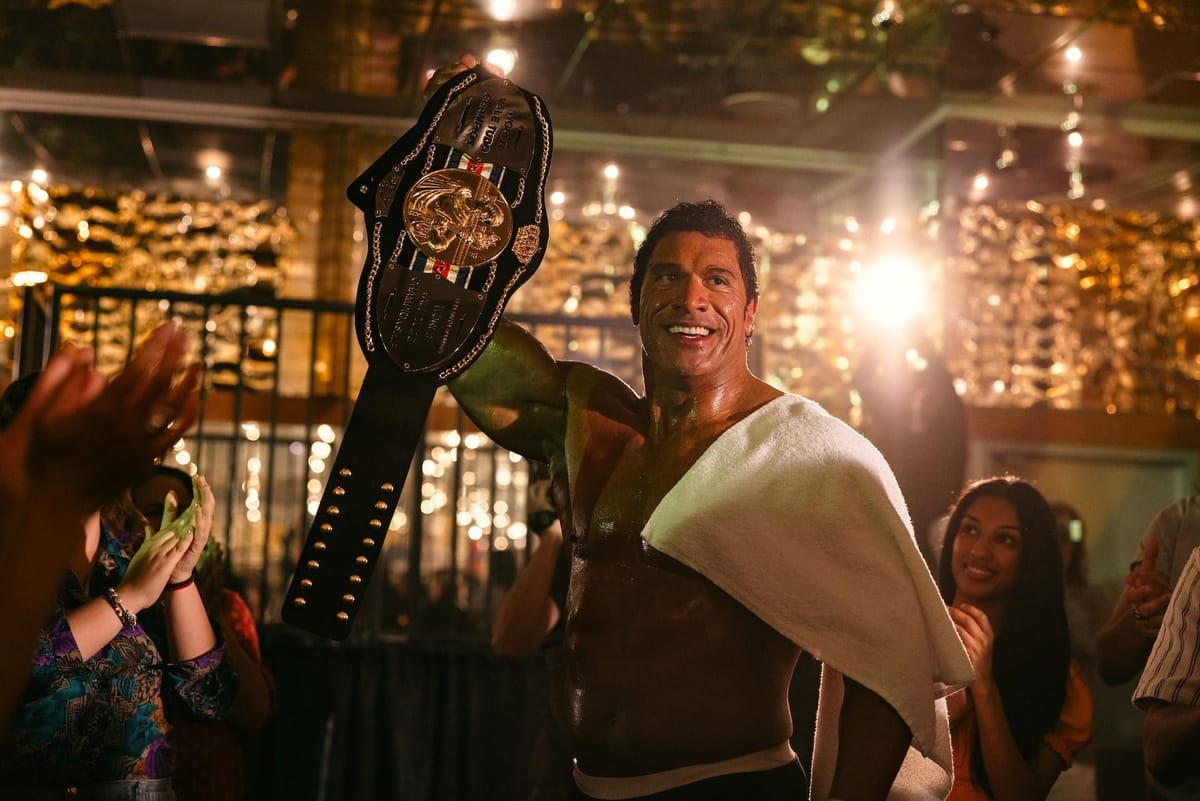
The Smashing Machine functions as a useful reset for Johnson's career. Although Johnson flirted with an auteur-driven movie early in his career by co-starring in Southland Tales, most of his movies were designed to meet a mass audience, even if they were a tad off-kilter, like the dark comedy Pain & Gain. By comparison, The Smashing Machine is a straight A24 biopic about MMA fighter Mark Kerr, written and directed by indie filmmaker Benny Safdie, who, with his brother Josh, made Uncut Gems and Good Time, among others. If Safdie could take actors like Adam Sandler and Robert Pattinson, respectively, and give them material to expand what audiences could expect from those performers, then perhaps he was also a good fit to help Johnson change his image.
There's nothing inherently wrong with this pivot, and actors tend to do it consistently in an attempt to not only find challenging material but also stay relevant in a competitive line of work. Johnson is a savvy businessman, and while The Smashing Machine is an A24 release and played major festivals, it is still part of Johnson's career project. He's a producer on the film alongside his longtime Seven Bucks partners Dany and Hiram Garcia. "Career rehabilitation" may be overstating his turn here, but Johnson also knows that a sequel to Red Notice isn't going to help his long-term career prospects at this point.
All of this prologue is necessary because Johnson, as a bankable star, could have chosen plenty of lower-budget dramas in which to make his first, serious dramatic performance. He chose one about Kerr, a fighter who has to learn what it is to lose. Kerr's journey in this movie dances with the standard sports biopic boilerplate of rise-fall-redemption, but the deeper subtext is about a guy learning to understand the importance of defeat. When asked early on by a Japanese reporter what he would feel if he lost, Kerr doesn't understand the question. Safdie makes great use of the story, repeatedly returning to Japan (where the MMA organization, PRIDE FC, was holding bouts during the film's time period of 1997-2001) to show how Kerr's thinking is literally and figuratively lost in translation. He can't understand most of the people around him, and he can't communicate an identity outside of victory.
To the film's credit, Safdie and Johnson build a compelling figure out of a guy who can't abide defeat but doesn't play as overly macho or even hyper-competitive. The movie thrives on the juxtaposition of taking a big man, played by a big movie star, and then having all of his non-fighting actions read as small and intimate. Kerr is soft-spoken, genteel, and when he steps into the ring, it's not because he hates his opponent, but because he finds ecstasy in the athleticism of physical violence. Safdie's insight is in working to separate brutal behavior from being a brute, and effectively argues that Kerr is his best self when he's in the ring because that's the way he can express his love of physical combat.
The contrast of his feelings inside the ring and outside the ring is rendered early on when Kerr, after his first loss (which he gets overturned to a "no contest," because he can't handle losing), greets his Russian opponent with smiles and warmth. He's a fellow warrior, and while some may have seen the victory as relying on dirty moves, Kerr has nothing but love and respect for another fighter. This is set next to how much passive aggression and tension there is with his girlfriend, Dawn (Emily Blunt). The Smashing Machine seeks to rest on the central irony that Kerr shows love to those he has to fight, but for the woman he loves, there's only hostility.

Unfortunately, that central irony isn't enough to power the whole movie. Dawn is too much of a dead-end character, depicted largely as an albatross around Kerr's neck. While it's a nice way of upending the typical dynamic of the long-suffering spouse who backs her fighter (Adrienne in Rocky and countless female lead characters who came after), nothing is ungirding her behavior or providing any shading beyond Blunt doing her best to find some pathos to a character largely written as selfish and manipulative. There was an avenue to make this a more interesting story about how Kerr perceives love and why he can accept it when a competitor smashes him in the head, but not from his girlfriend trying to make him a smoothie, but that would require giving Dawn some positive attributes.
Even the movie kind of accepts it as a dead-end despite a blow-out fight set to the entirety of Bruce Springsteen's "Jungleland" (a nine-minute and 35-second song) because the real catharsis comes later when Kerr goes to Japan and can focus on fighting and also cheering on his friend and fellow fighter Mark Coleman (Ryan Bader). This leaves Dawn less of a character and more of a problem to be solved with the larger emotional beats coming as Kerr works his way through a big tournament.
That tournament finish feels like it serves Johnson more than it does the film at large because while the Dawn and Kerr scenes offer good grist for drama (and Johnson clearly has a strong rapport with Blunt, having previously co-starred with her in Jungle Cruise), the culmination of the story is about Kerr finding peace without needing to dominate in his arena. Dawn is as problematic as his addiction to painkillers, but his happiness only arrives when he separates the joy in the work (training, fighting) from its outcome (needing to be declared the victor).
For Johnson, there appears to be a dual performance at work. There's the one inside the movie where we can all marvel at how an actor with so much bravado made himself look small, insular, and insecure. It's an act of "disappearing" while also wanting you to notice the disappearance and how different it is from his typical characters. The larger performance is for the audience Johnson has cultivated since becoming a WWF star in the 90s. It's for people who thought he only had one gear, and now he's going to show them he's not an empty blockbuster vessel. He, like Mark, wants to show us that he has a new set of skills and, through defeat, has become an even bigger champion. It makes for an interesting career moment for Johnson. I wish it made for a more interesting film.