‘I Swear’ Is a Lovely Call for Compassion
Kirk Jones’ biopic feels like a continuation of its subject’s mission to raise awareness about Tourette’s Syndrome.


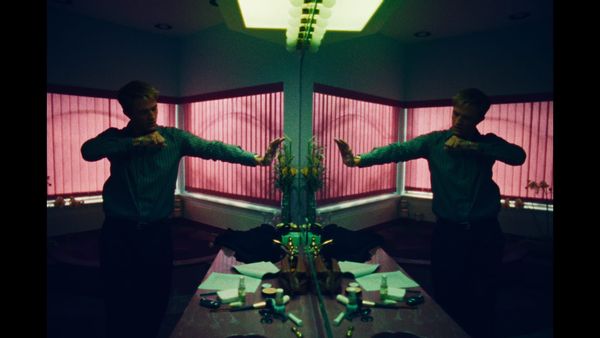
There’s an odd sort of humility at the center of Kirk Jones’ new movie, I Swear. Typically, the biopic requires some sort of distinction. We’re making a movie about this person because they’ve done something grand. And the film does begin with its subject, John Davidson, about to be honored by the Queen at a prestigious ceremony. But then he shouts, “Fuck the Queen!” and we get to the concept of John, which is his lifelong struggle with Tourette’s Syndrome. From there, while there’s a great performance at the center from Robert Aramayo, the larger portrait is about the community that comes to support him, and that heroism comes not from grand action, but from compassion and understanding.
Young John Davidson (Scott Ellis Watson) is growing up in a working-class neighborhood in Galashiels in the Scottish Borders. He aspires to be a football goalie, but in middle school, his tics start to emerge. He starts blurting out rude things, spitting in people’s faces, and no one understands why. His father leaves, and John even attempts suicide from how guilty he feels over his young life unraveling. He survives the attempt, but when we cut forward to Davidson as an adult (Aramayo), life hasn’t become much easier, as his mother (Shirley Henderson) appears to barely tolerate him. It isn’t until John meets Dottie (Maxine Peake), a mother of a friend and a mental health nurse, that someone compassionately understands his Tourette’s and that John is to be embraced rather than minimized. With the help of Dottie and Tommy Trotter (Peter Mullan), John’s boss at the community center, the young man starts to emerge from his shell and realize he can help others with his illness and raise awareness of Tourette’s.
It may seem odd at first to a modern audience that people in 1990s Scotland wouldn’t appreciate someone with Tourette’s Syndrome, but we need to look only at the controversy that erupted at the BAFTAs earlier this year when John’s tic caused him to blurt out the n-word while Michael B. Jordan and Delroy Lindo were on stage. John asked organizers to put him away from microphones and to make accommodations, and afterwards privately apologized to Jordan and Lindo, but some people wouldn’t accept that. “Nah, he meant that shit,” said Jamie Foxx. Watching I Swear, Davidson’s whole story isn’t just that he twitches or blurts out random curse words; his brain tends to blurt out the most offensive thing possible, like saying, “I have a bomb!” when he gets on a train or being unable to properly take an oath before testifying at trial.
In this light, it feels like the film’s mission makes sense because there’s no cure for Tourette’s. If even one of its best-known representatives can’t suppress tics at public ceremonies like the BAFTAs or being named MBE by the Queen, then perhaps the call isn’t on the individual but on the rest of us. It’s an interesting inversion where Davidson’s heroism is just getting up and going out into the world each day, but we’re meant to be inspired by Dottie and Tommy, who embrace John and recognize he’s a nice guy with a horrible condition. If we shun him from society, that is ultimately a reflection on us.
The most curious aspect is the omission of Davidson’s participation in the BBC’s 1989 television documentary John’s Not Mad. There are clips from this over the credits, but watching I Swear, you would think his Tourette’s wasn’t seriously addressed until he was an adult. Perhaps UK audiences know the documentary better, and so, as a UK production, Jones felt revisiting it was redundant, but in a story about raising awareness, it’s a bit odd to leave out something that clearly raised awareness.
And this is one of those cases where “awareness” means something rather than an empty buzzword for doing something but not actually changing anything. If more people know about Tourette’s and understand it, then the social stigma decreases, and those suffering from the disorder won’t feel ostracized. I Swear feels like another effort in that endeavor that’s become a cornerstone of Davidson’s life. The challenge of the film isn’t for Davidson to overcome Tourette’s, but for the rest of us to embrace those who are different. It’s a refreshing approach to show that an ailment isn’t there to be defeated. Instead, we have to overcome the hardness of our hearts. That’s a tall order, but I’m glad I Swear asks it of us anyway.
I Swear opens in U.S. theaters on April 24th.
Want to support this newsletter, but don't feel like a paid subscription at this time? Consider making a one-time donation.