‘Buddy’ Can’t Cut Deeper Than Its Basic Dark Comedy
The comic incongruity of children’s programming with slasher horror never coheres into anything more thoughtful.

In 2014, Adult Swim quietly unleashed the bizarre and delightfully twisted short “Too Many Cooks,” which took the simple premise of a sitcom opening credits and kept building it into new designs and new forms, which caused a horrific dissolution of the world’s interior reality. For folks like me who enjoy when something bright and cheerful becomes abruptly dark and twisted, it was great to see everyone’s reaction to such a singular remix of familiar tropes. Its creator, Casper Kelly, returns to that well with Buddy, a movie that uses the springboard of a 90s kids TV show a la Barney & Friends, to become a slasher flick. And yet while Kelly’s comedy can sustain an 11-minute short, it flags at feature length with not much more to go on than pitch-black violence occurring to and in front of children. While there are nods that such children’s TV pablum is harmful in its own way, the media critique is puddle-deep, especially since we know the real harms children are subjected to in the entertainment industry. Buddy may want to point out the cruelty of interchangeable children in children’s TV but feels far more obsessed with its slasher imagery.
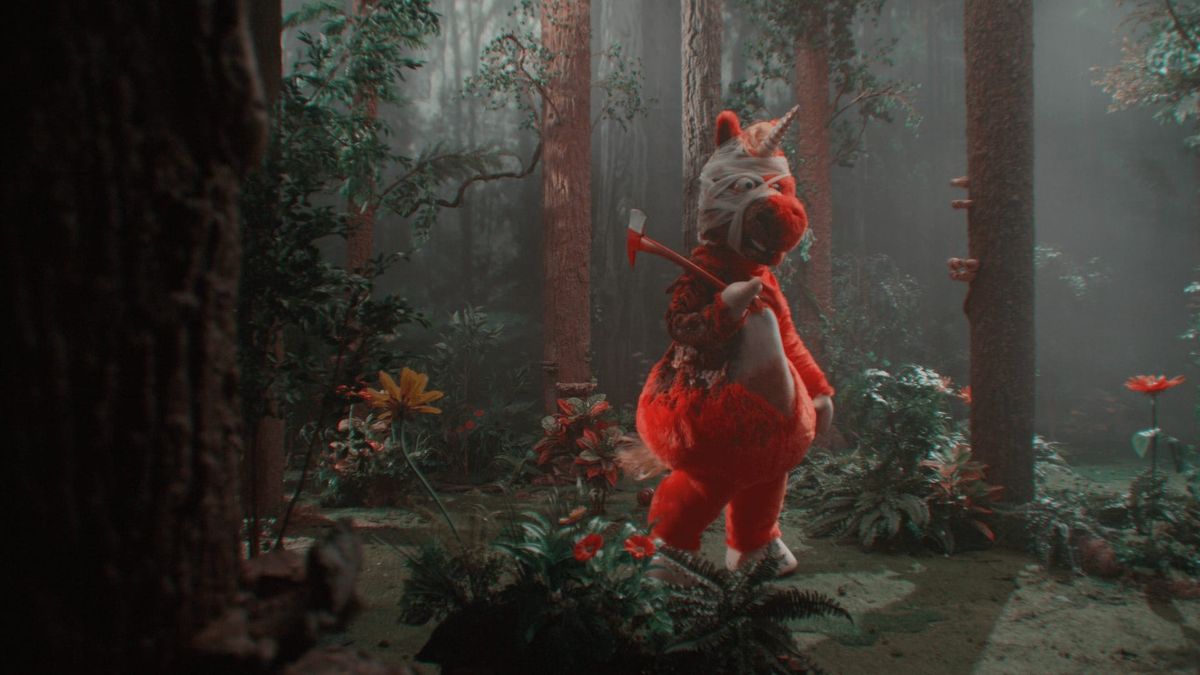
The first act of the film could have been an Adult Swim short in the style of “Too Many Cooks,” as we’re introduced to the show “Buddy,” a singing, talking, cuddly orange unicorn (Sergey Zhuravsky in the suit, Keegan-Michael Key as the voice) who, with the help of his anthropomorphic friends, teaches lessons to a quartet of kids. However, Buddy has a short temper and can warp reality to his will. When Freddy (Delaney Quinn) discovers that a fellow youngster has gone missing and the book he was reading is stained with blood, it leads to her and her fellow children running from the violent, vengeful Buddy.
From there, the movie attempts to build a plot about what Buddy’s world looks like, how these children got there, how they’re replaced, etc. For a feature, the simple gag of “This children’s cartoon is actually quite dark” now requires world-building and characters, but it all serves more as beleaguered exposition rather than anything emotionally or thematically rewarding. If anything, it only highlights that despite its basic set-up, the first act is the most interesting as it critiques children’s programming as empty drivel, a mere distraction built around hero worship rather than encouraging kids to learn anything worthwhile or exercise their imaginations. Moreover, these shows have limited use for the range of a child’s emotions, so when a kid like Josh (Luke Speakman) is angry or upset, he’s not “getting with the program,” and must be punished by Buddy.
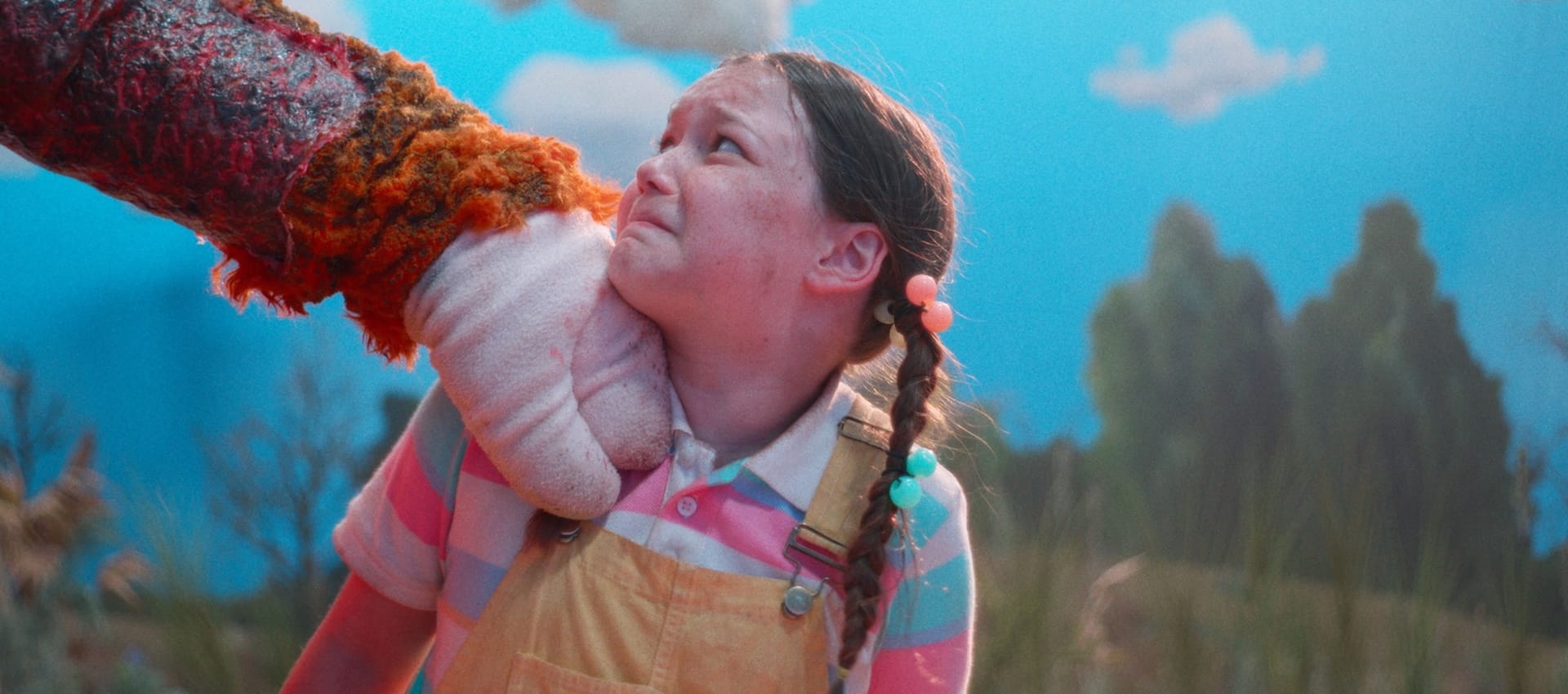
It’s all comically grim, and your mileage will vary on how much you want to see an angry orange unicorn attack children. It’s not that this dark parody of children’s programming can’t work—I was a fan of the lunacy of the TV series Wonder Showzen—but it also works better in bursts rather than trying to sustain an entire film. There were moments where I laughed, but as Buddy wore on, I couldn’t help but think, “Is this all there is?” The joke of a children’s mascot attacking the children runs dry, and Kelly finds himself boxed in, unable to deviate from the twisted premise, yet he’s built nowhere to go beyond the children’s escape. It’s all painfully one note, with any attempts at pathos undermined by the broadness of the gag.
This shallowness particularly rankles in the aftermath of the death of Hayden Panettiere, a child actor chewed up by the system and who died last week at the age of 36. Alison Pill, who has worked as an actor since childhood,recently wrote an editorial arguing that when it comes to being a child actor, “No one deserves that fate.” She’s far from the first to share that view, and we saw something similar with Jennette McCurdy’s 2022 memoir I’m Glad My Mom Died. As well-regulated as any TV or film set may be, Pill is correct that child acting is “extractive, exploitative and nonconsensual.” The connective tissue of the industry—the rejection, the long hours, and constantly being around adults rather than fellow kids—carries too high a price. Buddy’s joke is intended to take what’s wholesome—a children’s program—and corrupt it with violence. But while Barney the Dinosaur never came at kids with an axe, we know there’s still a body count. The movie argues that kids are being captured by bad TV, but, like the programs it’s mocking, it also denies the interiority of children. In a normalized kids’ TV program, they’re playmates. In Buddy, they’re victims. Either way, they’re not individual people.
Perhaps I’m getting less irreverent and less fun as I get older. Perhaps something like Wonder Showzen wouldn’t amuse me now like it did when I was in college. But I do feel that if you’re going to put pre-adolescent children into a horror scenario, you may want to pause and consider what would actually be horrific. Despite Freddy being the film’s protagonist, the film plays as largely indifferent towards her personhood or that of any of the children. Instead, she’s made to fit within Kelly’s larger joke about banal television gone violently awry. But what’s horrific isn’t the evil unicorn. It’s that Quinn and her fellow child actors are going to go back to auditioning, back to the grind of an adult job, and I suppose that’s just too real to laugh at.
Buddy is now playing in theaters in limited release.
Over at Decoding Everything, I reviewed The Dog Stars:
 Matt Goldberg
And in case you missed it, I reviewed Coyote vs. Acme, which opens in theaters on Friday.
 Matt Goldberg