In Christopher Nolan’s ‘The Odyssey,’ We’re All Strangers in a Strange Land
Nolan's lush, tactile film makes a for thoughtful, bracing conversation with Homer's epic.

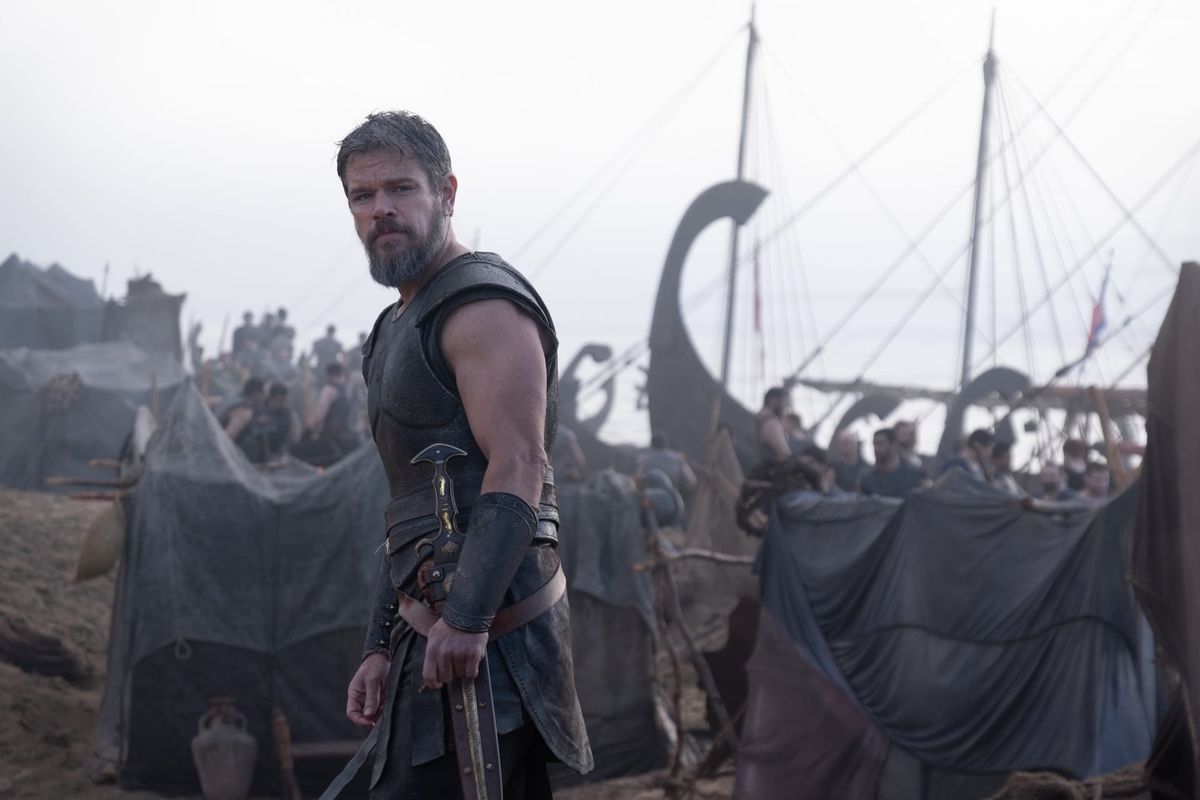
The world of Homer’s epics resembles ours, but it is not ours. There are men and wars and family and regrets and hopes, but there are also gods, fate, and magic. Furthermore, it is a world defined by particular values, and in The Odyssey, the rules of hospitality are some of the most ironclad. The greatest departure in Christopher Nolan’s opulent rendering is breaking those rules and showing a civilization in decline as neither host nor guest has any reverence for each other. Themes of memory, loss, guilt, and war are also present, but the driving thematic momentum is that a man cannot come home when he’s trespassed against what we owe the stranger. Through the travails of Odysseus (Matt Damon) and his crew, we travel not back to a rich land of gods and magic, but one of decay and ruthlessness that resembles our own.
Odysseus has been gone for decades. To protect his family and his people in Ithaca, Odysseus agreed to sail with King Agamemnon (Benny Safdie) to raid Troy. With Odysseus gone, suitors such as the snide and deceitful Antinous (Robert Pattinson) have made their way into his home, hoping to marry Odysseus’ wife, Penelope (Anne Hathaway). Odysseus and Penelope’s son, Telemachus (Tom Holland), is not of age to take the throne, and killing the suitors would only bring further bloodshed. While Telemachus leaves to find word of his father’s whereabouts, Odysseus is stranded with Calypso (Charlize Theron), trying to remember who he was and what happened to his crew.
Although I have quite a few issues with Nolan’s 2020 feature, Tenet, it has a line that feels like it’s the guiding ethos for the protagonists of his past three movies: “Don't try to understand it. Feel it.” Both Odysseus and J. Robert Oppenheimer are afflicted with the same icy intelligence; an ability to unravel the universe as they understand it while only realizing the cost of their genius too late. They become celebrated for their accomplishments (The Odyssey opens with a poet telling of the famous Trojan Horse) while wrestling with the idea that their greatest achievement may be humanity’s downfall. The challenge for both men is to break free from the safety of their intellect and actually feel the repercussions of their actions, as painful as it may be.
Thankfully, The Odyssey is far more coherent than Nolan’s time-traveling spy thriller, and if anything, he uses the familiarity of the narrative to deepen a conversation with what we think we know. In this telling, the battle for Troy was not to bring Helen (Lupita Nyong’o) back to Agamemnon’s brother Menelaus (Jon Bernthal), but an excuse for Agamemnon to control trade routes. Odysseus continues to presume that “Zeus’ law” of hospitality—that the host must welcome the stranger—is always met with misfortune, like when they come into the cave of the cyclops Polyphemus (Bill Irwin), and Odysseus’ second-in-command, Eurylochus (Himesh Patel), replies, “What if he doesn’t know about Zeus’ law?” Time and again, Odysseus and his crew show up in a foreign land hungry and unwanted, and they pay the price in blood and suffering.
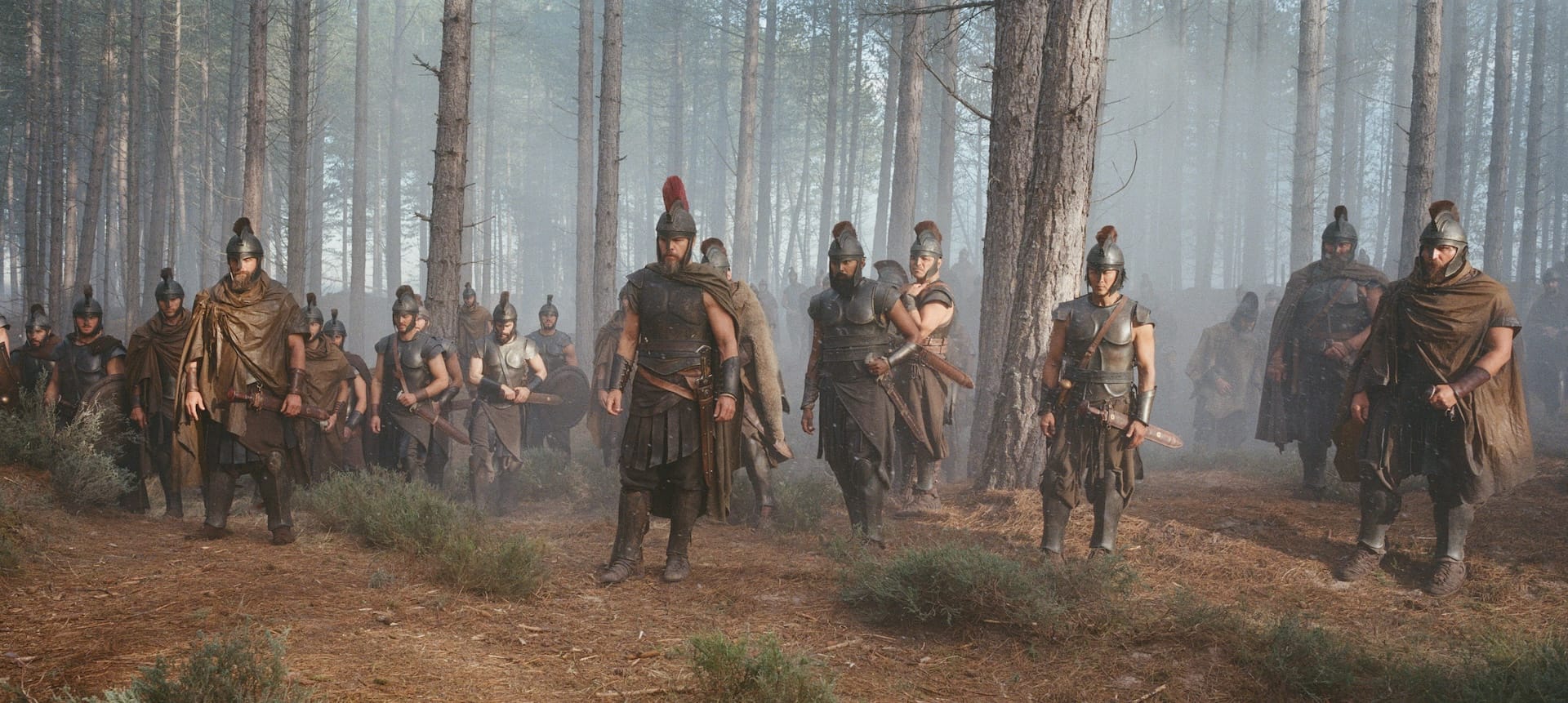
There are times in the middle section where this can drag on a bit, and you could argue that such an arduous repetition is meant to emphasize the wandering of the characters. It does become almost comical that these guys keep washing up on some strange place, and the result is almost always a variation of King Arthur in Monty Python and the Holy Grail shouting, “Run away!” And yet this dynamic of cruel hosts and presumptuous guests is the key to the entire movie. More than a story of Odysseus’ hubris and regrets, it’s a story of how the world no longer works when we decide we no longer owe each other anything. We see those reverberations out in Ithaca with the suitors scamming Telemachus out of his birthright and in Telemachus’ journey where his welcome in Menelaus’ home is far more tense than the idealized greeting in Homer’s poem. Nolan accentuates a story of wandering by showing how no one is wanted anywhere, and even those who are technically “at home”—Penelope, Telemachus, and Odysseus’ faithful servant Eumaeus (John Leguizamo)—are not at peace.
It’s difficult (at least for me) not to see the political lens here. Nolan lives in the same world we do, where immigration has become a salient issue both in the U.S. and Europe. So much of the original text is about how we welcome the stranger and how we ensure his safe travels. In a world of isolationism, the human desire for food and protection does not disappear, but instead, every interaction becomes painfully fraught. The idealized welcoming of strangers, as kings Mentor and Menelaus act in Homer’s epic, is too foreign to our world. It’s not that Nolan has some detailed policy on immigration, but he does seem to argue that in a world where no one is welcome, all will be lost.
I assume you could also take an opposite viewpoint that Odysseus and his crew represent the immigrant “hordes,” presuming on the charity of their host like Polyphemus or Circe (Samantha Morton), and thus the movie is one that would bolster isolationists. However, the film’s culmination, and in particular how it rethinks the legend of the Trojan Horse, brings the story together in a deeply satisfying way even if some leaden lines of dialogue to hammer home the point could have been dropped from the script. In its conclusion, the film doesn’t equivocate on the damage done by breaking the bonds of guest and host, and that any short-sighted victory will lead to damning repercussions.
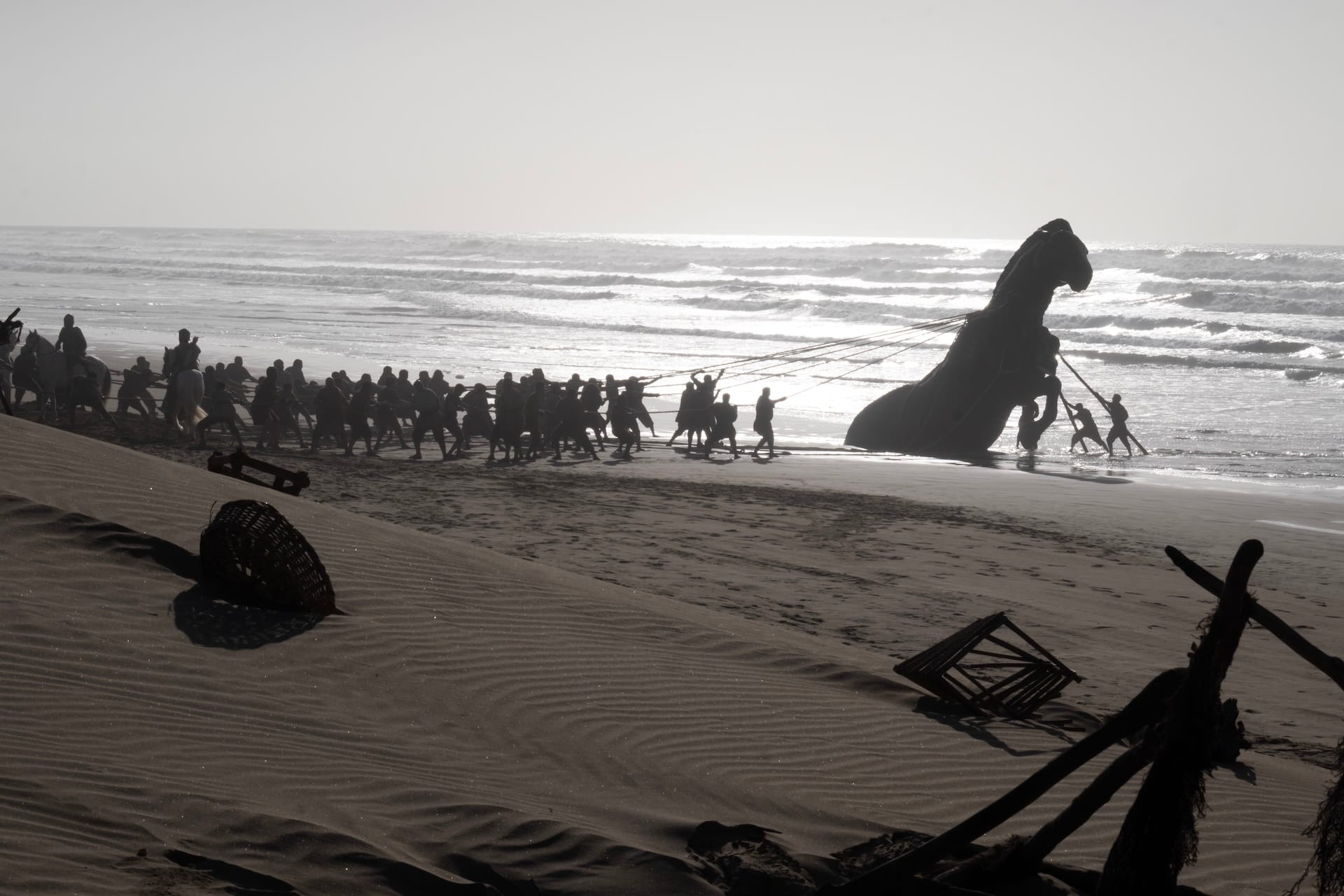
Minor qualms tend to fade a bit in the face of the overwhelming craftsmanship and the excellent performances across the board. There’s rarely a doubt that when you see a Christopher Nolan movie you’re going to be treated to some of the finest cinematography, production design, costuming, etc. that any major studio blockbuster has to offer. But his commitment to the physicality of the journey helps the film stand out from its expensive peers. Sure, there’s CGI here, but even in the case of a creature like the cyclops, it allows for Irwin to give a physical, emotional performance. He is monstrous, but also unmistakably human, and it makes the cyclops’ confrontation with Odysseus and his troops more immediate and horrifying than just another set piece.
Haunting, disturbing moments permeate the journey, making every detour feel treacherous and troubling in its own way. The creativity on display is particularly surprising, like when Circe turns the crew into pigs, which allows Nolan to showcase a talent for body horror we didn’t know he had. And yet he never loses sight of his performers, and so a scene where Odysseus visits the land of the dead still has all the emotion alongside the vivid rendering of the shades because of the great turns from the entire cast. We’re never overwhelmed by spectacle because we don’t lose sight of the human stakes.
The Odyssey is a film I’m eager to revisit (next time in IMAX 70mm as opposed to the 70mm that was used for the press screening) because there’s so much to unpack across its three hours. But it’s a sharp adaptation that understands it’s not simply a matter of transporting text and action to a different medium, but to engage with what it says about an ancient world compared to our modern one. Homer lives not only because of his poetry and creativity, but because of where we meet and where we depart from his world. Rather than total fidelity, Nolan provides thoughtful reappraisal, not deconstructing or obscuring the text, but using it as a vehicle to speak to how we treat each other today. That’s a journey worth taking.
The Odyssey opens in theaters on July 17th.
Want to support this newsletter, but don't want a paid subscription at this time? Consider making a one-time donation.