‘The Devils’ Is More Than Shock and Censorship
How the film’s tumultuous past speaks to our bizarre present.

There are movies from the past where the hand-wringing over their content seems almost quaint. The pre-Code era films of early Hollywood were deemed so shocking with the mere innuendo of sexuality that they contributed to the rise of the industry’s self-censorship, and yet today you could probably show them during primetime television without any consternation. Still, there have been uproars in the more recent past, particularly where religion is concerned. Movies such as Dogma and The Last Temptation of Christ caused an uproar as their Catholic filmmakers engaged with faith in ways the Church deemed heretical or disrespectful.
Preceding these movies was Ken Russell’s 1971 drama The Devils, which was controversial and censored before it could even arrive in U.S. and U.K. theaters. The nature of its content and the fact that Warner Bros., the studio behind the movie, wouldn’t release Russell’s version for decades only added to its mythos. Now, the movie finally arrives in a restored director’s cut, a painstaking work to bring Russell’s vision to the big screen fifteen years after the filmmaker’s death. It is a cause for celebration among cinephiles, and, notably, met with kind of a shrug by the culture at large. There’s far more to wring our hands about these days.
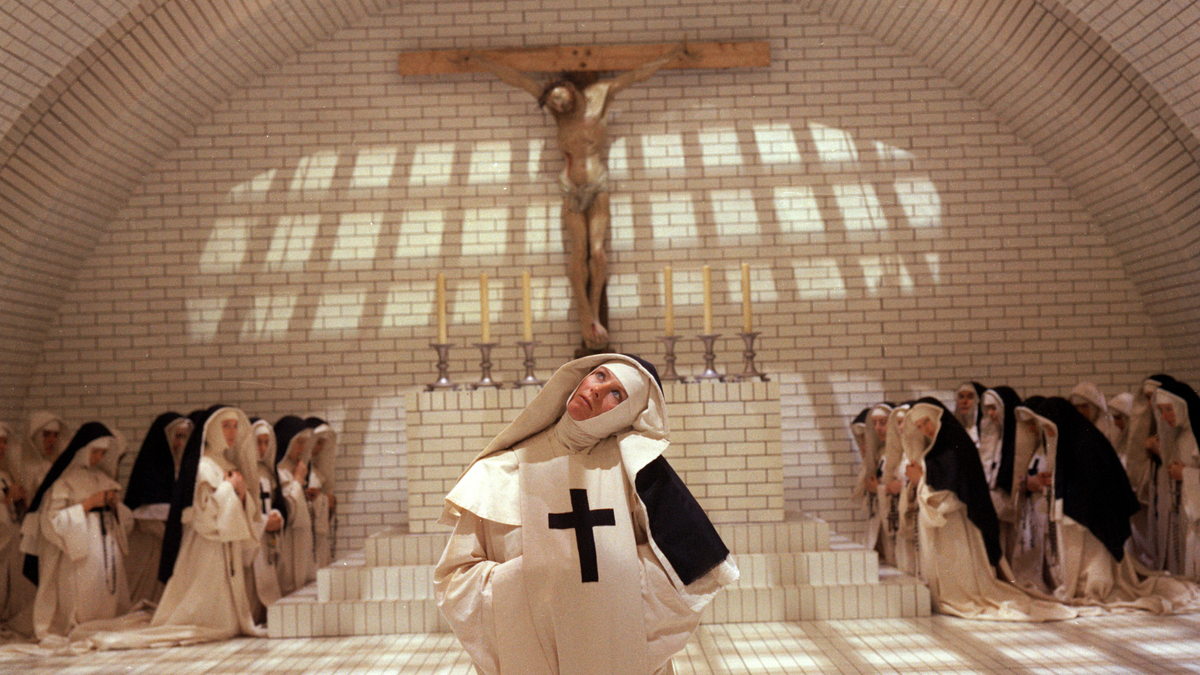
For those unfamiliar with the movie, it’s based on true events in 17th-century Loudun, France, where a sexy, charismatic Roman Catholic priest, Urbain Grandier (Oliver Reed), is accused of witchcraft after Cardinal Richelieu (Christopher Logue) conspires with Baron de Laubardemont (Dudley Sutton) to oust the popular iconoclast, whom Richelieu views as a threat to his plans to consolidate power. To do this, the Baron works with “witch hunter” Father Barre (Michael Gothard) to prove possession of Sister Jeanne des Anges (Vanessa Redgrave), a sexually repressed nun who lusts after Grandier despite never having met him.
There’s a simpler version of this story where Grandier is an upstanding, pious man whose great sin is wanting political independence from Richelieu’s machinations, and an easy story of using the devil to showcase the wickedness of man. But Russell’s adaptation never gives the audience such an easy hook because Grandier is deeply flawed. Reed gives a towering performance, and early on shows us Grandier as a man who leans into his shortcomings. He sleeps with his Latin student Philippe Trincant (Georgina Hale), the magistrate’s daughter, impregnating her but refusing to take any responsibility for the child. Instead, he turns his affections towards the sweet Madeleine De Brou (Gemma Jones), who loves Grandier in spite of, and arguably because of, his flaws.
The messiness of the Grandier character is an attempt to parse the nature of sin, especially as it relates to sexuality. He is not chaste; he doesn’t seem bothered by sex, and yet what pounds at the film is the question of when licentiousness slips into callous hedonism. We see that from the opening scenes where King Louis XIII (Graham Armitage) displays himself as scantily clad Venus in a show for his court. The Devils is fully aware of what counts as transgression, and yet wonders what strikes at the conscience, at morality, and at society at large. It is shocking when the nuns in Sister Jeanne’s convent dissolve into a frenzy of mass hysteria of sexual appetites, but “the devils” making them do it are the machinations of the state, which only a scene earlier had threatened to kill them for treason. Have the sisters truly given themselves over to sexual pleasures, or are they performing a show of hedonism as a matter of preservation?
What makes Gardiner heroic within this framework is that he owns his failings. He admits to being vain and proud, but he also never confesses to being under the power of Satan (“I lack the humility,” he quips). Saying “The Devil made me do it” is an act of cowardice, and that cowardice ranges from the cruelty of Father Barre’s supposed exorcisms to the pathetic behavior of Sister Jeanne, who feels such a deep well of shame for being aroused by Grandier. The film never says religion is nonsense, but rather that it’s too easily twisted by those who have the power to wield violence.
Watching the film, you can see why this would be upsetting to religious groups in the 1970s, and theoretically, it should be even more upsetting now given that this is the totality of Russell’s vision with the censored scenes now reinserted back into the picture. And yet, despite the rolling culture wars that never stop in the age of social media, the film has been met with approval of its intended audience. External forces haven’t noticed, or don’t mind. Maybe it’s because outrage used to be somewhat genuine, and now it’s done to gin up views so people whine about bigger movies like Barbie or The Odyssey. Even when it comes to Catholicism, the current Pope is a fan of movies and art. Meanwhile, the Vice President is a convert to Catholicism, but seems to dislike the Pope. The fact that The Devils is bracingly irreverent doesn’t seem to bother anyone because everything has gone topsy-turvy.
While the lack of controversy may not be great for box office, it at least means viewers can finally come to it with clear eyes, the hindsight of history, and still retain the interrogation of faith, power, and frailty that the film provides. Russell constructed a gorgeous movie, but it’s not an easy one, and the best films about faith rarely are. What makes The Devils troubling isn’t the acts of carnal debauchery, but the knowledge that faith may not be enough to stand against corruption. Like the walls of Loudun, they appear to be a mighty fortress, but they’re no match for ambitious men with designs of power. The world has only become more confusing since The Devils first arrived in 1971, but the film hasn’t become any less relevant. It’s still Russell’s masterpiece, and in these troubling times, it’s weirdly refreshing that we can finally go to a theater and see such a troubling picture.
The Devils is playing in limited theatrical release from October 16 – October 22.