‘Verity’ Is Too Tasteful to Be Trashy
Michael Showalter’s adaptation of Colleen Hoover’s novel offers staid storytelling rather than pulpy erotic thrills.


When you watch Verity, I suspect you’re supposed to be thinking about the story and the characters and the inevitable twists and turns this thriller will take. But I spent a large chunk of the time thinking about the house where most of the action takes place. Did they build the house for the movie? No, it’s real. Who designed the house? What ideas can I take from its décor to apply to my living space? What’s real estate like in that part of the country? The mind does wander a bit when the production design easily overwhelms the dry, plodding story of a film that needs to be far nastier and more delectable given its genre. Director Michael Showalter feels like he would be a good fit given his ability to move between genres and his comedic chops, which know how to get a laugh from dark or strange moments. But Verity moves like molasses, too wedded to a sense of intrigue to lean into its campier moments. Instead, you’re left with an erotic thriller that’s rarely erotic or thrilling but would make for a great piece in Architectural Digest.
Lowen Ashleigh (Dakota Johnson) is a struggling novelist grappling with the recent death of her mother and the loads of debt left behind. Her agent Corey (Ismael Cruz Cordova) gets her a meeting with Hachette Book Group, which has a unique offer. The bestselling author Verity Crawford (Anne Hathaway) owes the company three more books but is unable to finish them. Her husband Jeremy (Josh Hartnett) says Verity loved Lowen’s book and believes Lowen is the one who can make sense of all of Verity’s notes and outlines to complete the work. Lowen agrees and comes to live in the Crawfords’ house in Vermont. Once there, she learns that Verity can’t work because she’s catatonic from a car accident. However, that’s only the tip of the iceberg when Lowen finds a confessional autobiography from Verity, discovering that this revered author could be a real monster.
From its opening title card along with some darkly comic moments in the first act, one would think that Showalter is leaning into the pulpier elements like Paul Feig did with last year’s successful The Housemaid. And yet these fun bits fade away, and what’s left only reminds us of how everything the film has to offer is almost a watered-down version of what already exists. If you want to see Dakota Johnson in erotically charged movies, the Fifty Shades trilogy is available (they’re not good movies, but they do what they say on the tin for the sex scenes). If you want to see Josh Hartnett as seductive and untrustworthy, check out Trap (there were scenes where I wish I was just watching Trap). Hathaway does the most despite being on screen the least, as her narration caresses every word. She could read my obituary, and her voice would summon me back from the grave.
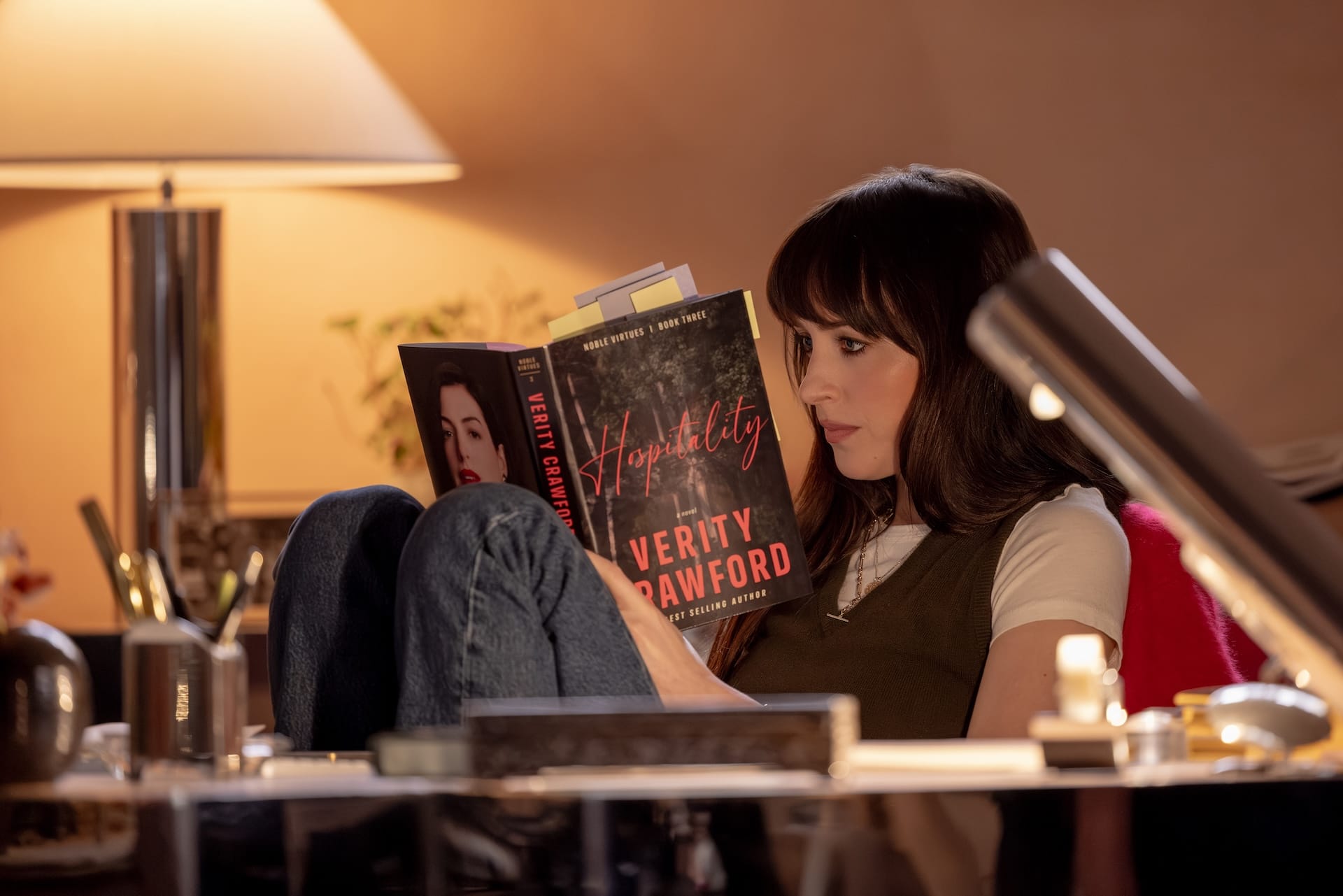
However, since Lowen is the protagonist, she holds the center of the film, and unfortunately, there’s not much character there. It’s not even so much a matter of Johnson’s performance (although, again, this feels like a pale imitation of Anastasia Steele) as much as there’s so little to understand the big swings the narrative needs Lowen to take. Her grief over losing her mother, her insecurity over her lack of success, and the riches laid before her in Verity’s life all make sense, but the movie also needs Lowen as an audience surrogate, and that’s tough because Lowen is supposed to have expertise as a writer. There’s a blank space for what writing means to Lowen, the books that matter to her, etc. The movie wants us to believe that Lowen is tempted by what she stands to gain from emulating Verity and coveting her home and family, but there needs to be a basic set of principles for corruption to matter. Lowen can’t lose herself because there’s nothing to lose, so her journey and decisions lack emotional weight.
The emptiness in Lowen exists alongside the richness of the setting. Perhaps Showalter wants to imply that Lowen is an empty page, eager to copy everything Verity built, but the production design doesn’t tell us anything about the characters beyond using the narrow hallways and pointed rooftops to imply a vaguely sinister tone. The film is so wedded to hiding its twists and reveals (which we know are coming, so we’re not trusting anything) that it loses a sense of purpose. The house can’t look like a place where a mother, father, and their children live—messy, strewn with the personalities of its inhabitants. Instead, it’s built for the satisfaction of the viewer, conveying a tone that serves no narrative or thematic idea. The house is beautiful and menacing, like Lowen believes Verity to be, and that’s where it stops, but it should be the starting point.
Beneath its pleasant designs, there’s an interesting idea in Verity about how much we read into authors and the truths we’re inclined to believe if it serves our desires. But very little of that comes alive in the movie. It’s a film aching for a pulse, but Showalter rarely gives the movie the oomph it needs. I don’t know if they wanted to keep it respectable or classy or what, but the choices here underline a film that frequently plays as constrained when it needs to be unleashed. It’s a movie that knows how to shock and delight with a splash of blood, but then gets lost in tired tropes, like a writer resorting to easy fallbacks rather than jolting the reader with the unexpected.
Verity opens in theaters on October 2.
Want to support this newsletter, but don't want a paid subscription at this time? Consider making a one-time donation.
And over at Decoding Everything, I reviewed Digger, which also opens on October 2.
 Matt Goldberg