‘Mouse’ Thoughtfully Explores Finding Yourself in the Aftermath of Loss
While the movie bears similarities to Kelly O’Sullivan and Alex Thompson's previous movie, 'Ghostlight,' it walks a messy path of its own.


My favorite film of 2024 was Ghostlight, and I’m a little annoyed that I didn’t figure out until recently that directors Kelly O’Sullivan and Alex Thompson had a new movie arriving (checks notes) today. That’s on me, but I’m so glad I saw Mouse, their latest feature, which, like Ghostlight, also deals with grief in the aftermath of losing a loved one who was only a teenager when they passed. Although the movies share other traits (another great performance from Katherine Mallen Kupferer, the use of theater as a way to convey both grief and healing), Mouse is its own animal as it’s a two-hander on the ways loss can break boundaries both for good and ill. There is no simple roadmap, and as a character says at one point, “There is no moving on; there’s only living forward.” It’s a film that acknowledges that not only do we all grieve in our own way, but the collision of those expressions makes for new, difficult relationships. With terrific performances from not only Kupferer but an awards-worthy turn from Sophie Okonedo, Mouse is the kind of rich character drama that feels like a gift.
Set in 2002 in Little Rock, Arkansas, the story follows Minnie (Kupferer), a shy teenager who only feels seen by her popular, extroverted best friend Callie (Chloe Coleman). Shy viewers will recognize this dynamic immediately as we cling to the person who everyone loves and, because they’re so outgoing and kind, makes us feel welcome and seen. On the first day of the summer break before their senior year, tragedy strikes when Chloe dies in a car accident. In a home with a mother (Tara Mallen) who always feels like she’s looking after every stray but never her own daughter, Minnie strikes a closer bond with Callie’s mother, Helen (Okonedo). Although they’re drawn closer together in their grief, fissures soon emerge as they both see that Minnie can never replace Callie, and there’s no way to fill the hole left by this special person.
What makes O’Sullivan and Thompson’s approach work is that they lead with deep empathy for their characters. It’s almost therapeutic to have filmmakers who are asking us to see where these people are coming from rather than jumping in with a critique like cinema is an “Am I the Asshole?” thread on Reddit. We know that the bond between Minnie and Helen isn’t healthy for either of them, and that Helen especially should have the wherewithal to try and look out for Minnie’s emotional wellbeing. But we know how much grief can screw someone up, and if we can accept that as motivation for pitting Captain America and Iron Man against each other, I’m pretty sure we can accept that a grieving mother may not be thinking with absolute clarity after losing her only child.
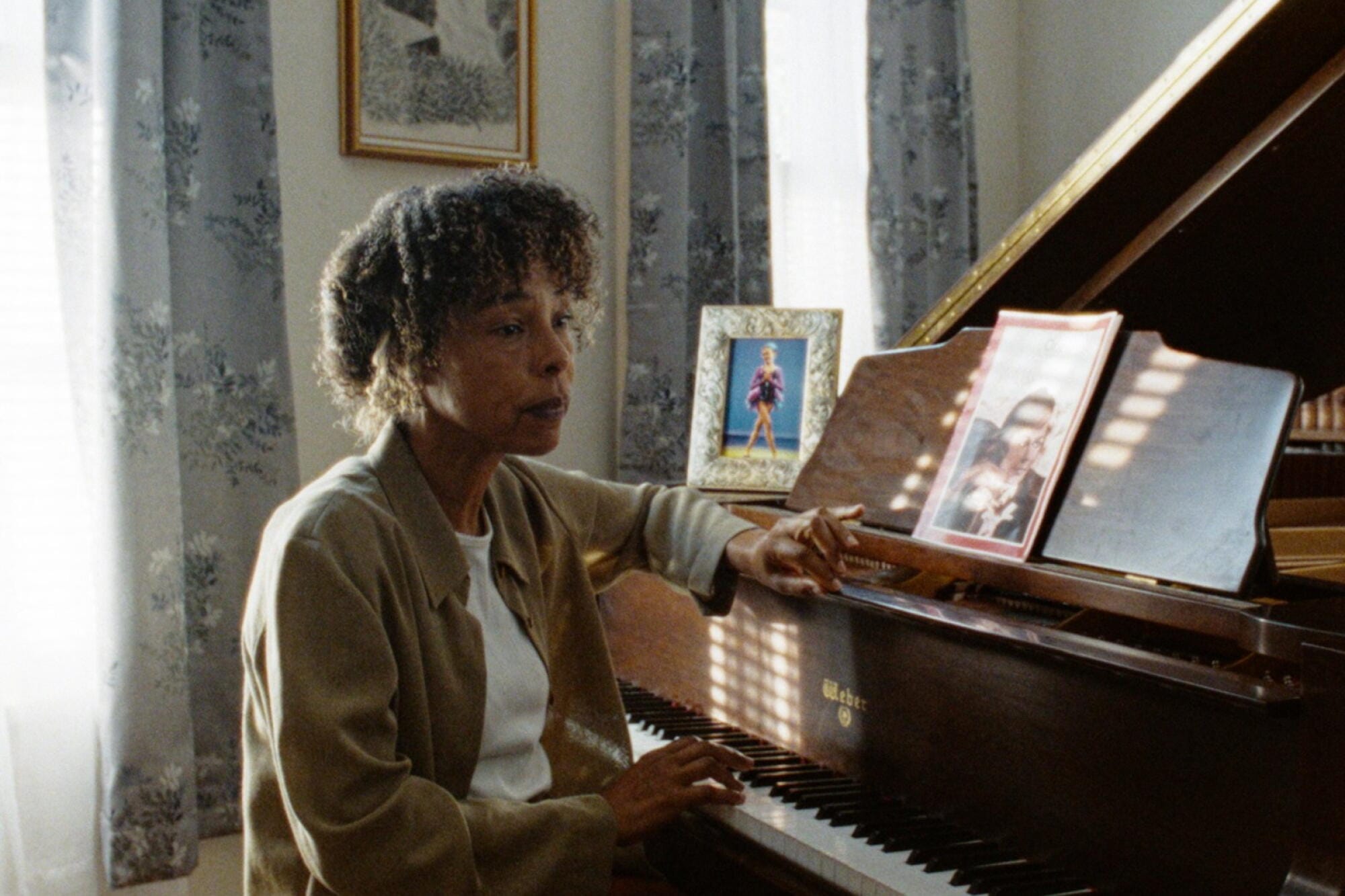
But part of that credibility rests on the actors, and both Okonedo and Kupferer are pitch-perfect here. It’s not enough that they’re playing the sadness of the scenario; they’re leaning into the mess of it all. Every imperfection they embrace is a risk because while we’re sympathetic, that’s not a blank check for every behavior. We need to question Millie and Helen while still wanting to see their journey, and the performances from both actors never let us look away. Grief provides rich emotions for an actor to play, but the performers know that’s only the starting point. Minnie has to find her identity and confidence beyond trying to recreate Callie. Helen has to figure out who she is if she no longer has a child to mother. It’s not merely the sadness of loss, but the fear of discovering who you are when losing a loved one means losing a part of yourself.
My one major qualm with Mouse is that the messiness of the emotions doesn’t always carry into the plotting. There’s a little too much tidiness in the three-act structure of it all, as well as the inclusion of one-dimensional mean girl Cara (Audrey Grace Marshall) or the sagacious drama teacher (David Hyde Pierce) who exists to deliver wisdom at a key moment. And yet, to keep the human stakes, I understand the narrative familiarity here. Part of what the film conveys is that the world itself keeps moving, unceasingly and without care, regardless of your grief. While perhaps there are more stylish ways to convey this, to do so would risk overshadowing the work of Okonedo and Kupferer, and that feels like too high a price.
While I feel like Ghostlight is the stronger of the two movies, that’s simply to the credit of that incredible work rather than the diminishment of Mouse. While it’s great that people are coming out to the cinema for mind-bending works like You Can See Everything or epics like The Odyssey, we also need small, human-scale dramas like Mouse that tap into real emotions. What makes a movie like this work isn’t that it’s hammering you over the head with sadness but rather embracing the totality of the aftermath and how those Kübler-Ross stages don’t neatly line up as a way through the pain. Mouse recognizes that grief isn’t only one thing, and that emotional turmoil is the spark of life in the shadow of death.
Mouse is now playing in limited theatrical release.