‘Hokum’ Is a Nifty Bit of Atmospheric Folk Horror
Damian McCarthy continues to nail the art of spookiness.

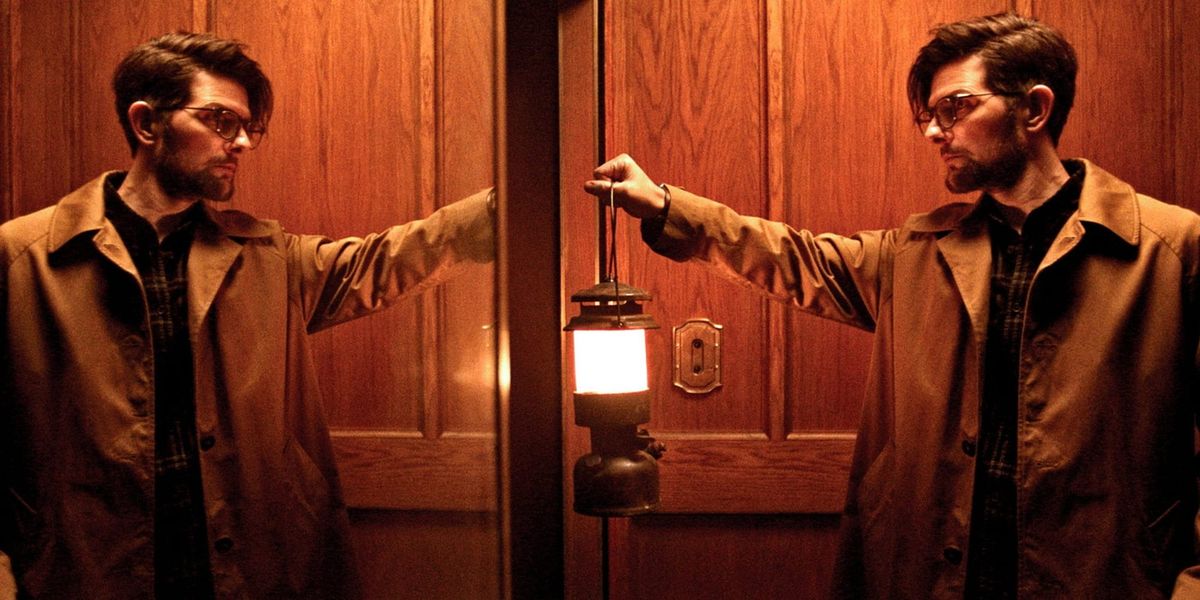
The biggest compliment I can pay Damian McCarthy is that his films Oddity and now Hokum feel like they’re anti-Conjuring. While the movies featuring Ed and Lorraine Warren are about staid, conservative forces fighting off literal demons, McCarthy knows that the devils are among us. There’s a supernatural bent, but as in good folklore rather than post-Exorcist/Christian-influenced horror, there’s a pagan earthiness to how our world interacts with the supernatural. There are rules, penalties, betrayals, and essentially a larger nature that must be respected. While some may find Hokum’s story a bit too simplistic or common, McCarthy’s patient direction leans heavily on a sense of dread and curiosity rather than jump scares. It exists not necessarily to horrify, but to fascinate, and makes for a neat little trip to a dark place with only a glimmer of light on the other side.
Ohm Bauman (Adam Scott) is a depressed author of a successful series of novels, and working on wrapping up the final installment with a bleak ending. Before he finishes the book, he heads to the Irish countryside and a cozy little inn where his parents were married. He figures it’s as good a place as any to scatter their ashes. Curt and dismissive towards the locals, Ohm shows only mild curiosity about others, but that curiosity is enough to prompt him to investigate the disappearance of one of the hotel’s employees. His search leads him deeper into the hotel, forcing him to confront the trauma of his past in a way that goes beyond the bleakness of his prose.
Although there is no shortage of The Shining references in the story, I think it’s all right to use the greatest hotel horror novel of all time as an influence. Where McCarthy wisely departs is in how he imbues the tone with a heavy dose of folklore. Where King’s book is about the specter of alcoholism and domestic abuse, and Kubrick’s movie employs a distinct perspective of the hotel itself, McCarthy roots his story in Irish folk heritage. It’s the “hokum” that Ohm dismisses when he hears it, further highlighting how he perceives his suffering as the only story that matters. The curiosity he lacks towards horror outside his own experience is what gives the rest of the movie its punch.
From there, it may be a matter of what you want out of your horror movies. Hokum may not click for fans of every horror stripe or those looking for NEON to deliver another Longlegs. But as someone who prefers a sense of spookiness rather than having my nerves shredded or unpacking narrative structure to get to a reveal, I liked going with Ohm on this journey. The reveal of his trauma is pretty obvious, but I still appreciate where McCarthy aims to take the character and uses folklore to unravel and redirect Ohm’s journey. It also speaks to how Ohm is far from the most likable guy, and McCarthy reiterates his view from Oddity that oddballs and outsiders tend to be more honest than those who present as strait-laced.
While there seems to be a bit of an uptick lately in horror films that are style over substance, Hokum works because its quiet style coincides with its limited story. Some may argue that it makes the material better suited for a short, but I would counter that a director has your attention for as long as they can hold it, and I was always with Hokum. It has terrific compositions, rarely relies on jump scares, and knows how to build tension in a thoughtful, confident way. Even at its most familiar, Hokum always plays as the real deal.
Hokum opens in theaters on May 1st.
What I'm Watching

The Pitt is amazing. Do people know about this? Someone should say something. I'm glad I found this little, under-the-radar show. Good for me.
I'm only six episodes in, but it feels like a powerful combination of the swift storytelling of network television and the narrative audacity you typically see on HBO. It's not like we've been without medical dramas, but following along on a single shift really does add an intensity that feels fresh and exciting in addition to the strong writing and great performances.
I'm also watching Margo's Got Money Troubles, and it's worth checking out just for the performances. The whole cast (led by Elle Fanning, Michelle Pfeiffer, and Nick Offerman) is fantastic, and the only thing I'm really puzzling over right now (and probably won't decide until the season ends) is if this could have been a movie rather than a miniseries. Right now, it's working fairly well as a show since it provides a chance to spend more time with the characters, but we've also seen shows that exist because streamers want you to spend time on their platform, and so they push for series rather than movies.
What I'm Reading
I don't want to say I'm on the downslope of Vonnegut's writing, but the back half of his novels is less well-known than the books in the first half. Slapstick is the weakest of his novels I've read so far, but even there, I found fascinating ideas and some sharp, dark comedy.
Also, I've decided that for my paid subscribers, I'm going to do a Vonnegut on Film series where I write about the adaptations his novels as well as the documentary Kurt Vonnegut: Unstuck in Time. I'm not sure when that will launch, but I'll provide a heads-up as I get closer to the finish line.
I also continue to break up the Vonneguts with other books, so right now I'm finally reading Lost Girls: An Unsolved American Mystery by Robert Kolker. I know the mystery has now been solved (it was Rex Heuermann), but it's still a powerful read because Kolker is interested in the larger reasons that would lead these young women to engage in sex work in the 2000s. It isn't (at least so far) true crime pablum.
What I'm Hearing
I've been listening to the new Metric album Romanticize the Dive and the new Noah Kahan album The Great Divide: The Last of the Bugs. They're both solid, but not without their bumps. Romanticize the Dive is catchy, but it's not sticking with me like Fantasies (my favorite of their albums) or Formentera. As for The Great Divide, there are some fantastic songs in there, but as a double album, there are also tracks that feel underwhelming when placed next to much stronger material.
What I'm Playing
I've been a little busy lately, so I haven't had a chance to dig into Mouse: P.I. for Hire, but I've enjoyed what I've played so far, even if the combat is a little bland. I've heard the game gets better as you unlock more interesting weapons, but right now it's basically an animated shooting gallery where you walk into a room, pop a few bad guys with your shotgun or pistol and move on.
Hopefully, I'll have it all wrapped up by the time 007 First Light arrives on May 27th.
Want to support this newsletter, but don't feel like a paid subscription at this time? Consider making a one-time donation.