‘The Devil Wears Prada 2’: Humility Is the New Black
The sequel is an inoffensive little victory lap with plenty of sympathy for the devil.

It would be nice for Hollywood to look at the staying power of The Devil Wears Prada and see that investment in mid-budget features about people doing a job is just as valuable as world-saving IP or nerve-wracking horror. The fact that the sequel, The Devil Wears Prada 2, is opening the summer movie season speaks not only to the quality of the original (it is a frequent comfort watch in the Goldberg household) but also to how it has built up fans over the last two decades despite showcasing a world that no longer exists. We still relate to Andy’s struggles, the difficult boss, and finding what you really care about when, at first glance, it just seems like a pile of stuff. The sequel isn’t a cheap knockoff, and the film attempts to wrestle with the difficulties of the journalism industry, but its foremost concern is to give these characters wins, bringing them a little lower so they rise to the challenge and let us cheer. That may not fully be in the spirit of the original, but there’s something to be said about dressing for comfort rather than style.
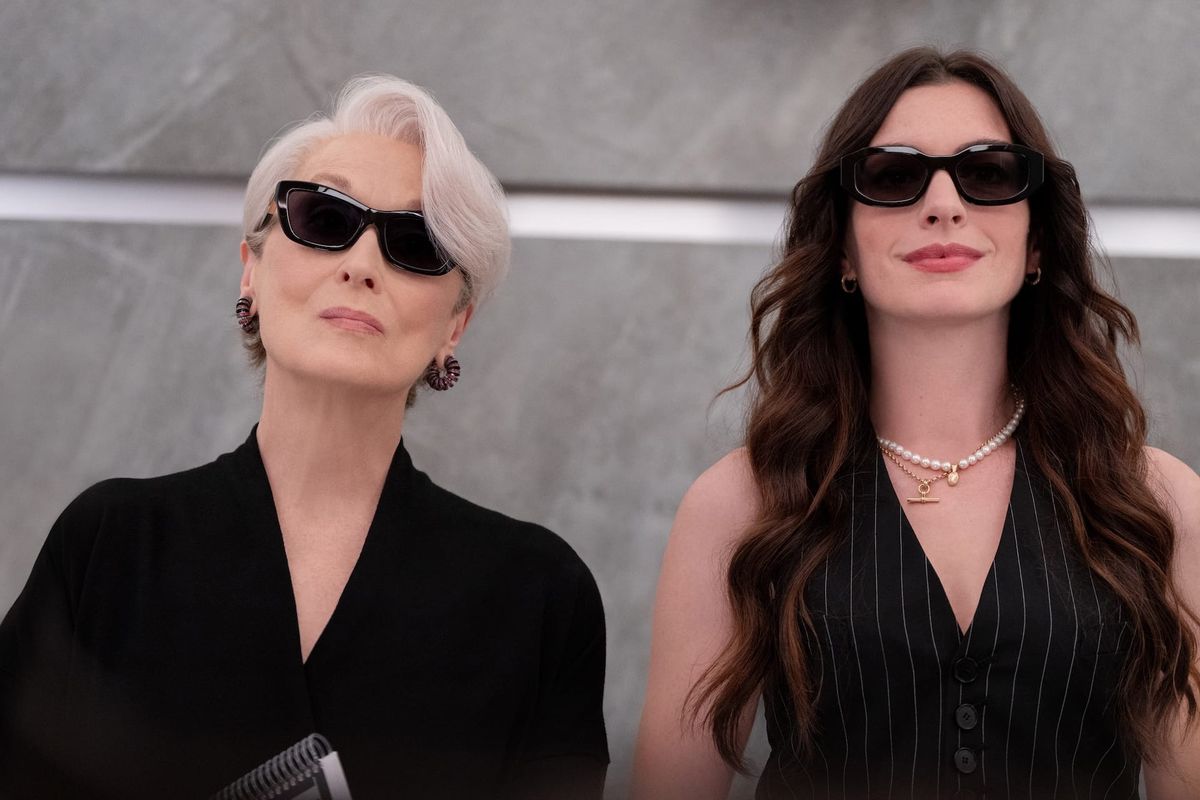
Picking up twenty years later, Runway magazine is in trouble. In addition to adjusting to all the tumult journalism faced over the past twenty years, they recently ran a shoddy piece that threatens Miranda Priestly’s (Meryl Streep) chances of becoming the global head of content for publisher Elias-Clark. Miranda’s old assistant, Andy Sachs (Anne Hathaway), is a successful journalist but needs a job after her paper shuts down while she’s at an awards ceremony. Elias-Clark head, Irv Ravitz (Tibor Feldman), selects Andy to run editorial for Runway. Miranda bristles at a selection made without her input, doesn’t even remember Andy, and Andy must recalibrate her journalistic instincts to fit with Runway’s model. Meanwhile, old colleague Emily (Emily Blunt) now runs advertising for Dior, and Nigel (Stanley Tucci) remains at Runway, the calm center of the storm. All four lives intersect again when an unexpected event puts the future of Runway in jeopardy.
There are a lot of moments where you can feel the film straining to believably put these characters in relatively new places twenty years later, and then give them a reason to be in the same room. Aline Brosh McKenna wrote a fairly elegant adaptation with the first movie, but the sequel poses a greater challenge as it needs to both mature and regress the characters. Her solution is to use the crumbling of the journalism industry to force everyone to struggle. Miranda wants something bigger than what she has, Andy wants to prove that journalism still matters, and so the film tries to exist in this middle ground where Miranda can’t be the boss from hell, but she also doesn’t view Andy as a colleague. It’s a balancing act of trying to reconstruct dynamics from the first film while also acknowledging how much has changed.
This means humbling the characters in such a way as to be believable, and the film is at its best when you have to see Miranda and Andy working for something rather than lapsing back into their old dynamic. In the first movie, Miranda was the one making Andy’s life terrible, and now they’re both trying to keep their heads above water. There’s a stronger overall film here about addressing the new challenges life keeps throwing at you, and how they’re harder to address the older you get. Andy looking for a job in her forties while her industry collapses could probably buoy an entire movie, but that’s not going to appease fans who want to see Nigel’s dry humor, so a viral moment instantly gets her the Runway position (however, if any billionaire who owns a media empire is reading this and needs an editor to drop in and revitalize your publication, I am available).
It all amounts to standard sequel fare where you have a film lean a bit into fan service, let everyone hang out with the characters again, show the cultural appreciation by upping the cameos, and then try to get out without it feeling too much like a cash-in. For the most part, it’s fine for what it is. While it never reaches the highs of Miranda’s entrance in the first movie or her withering quips, it’s pretty tough to slow down a cast that features Streep, Hathaway, Blunt, and Tucci. They all seem pretty happy to be back and aren’t phoning it in for a paycheck. It’s also a movie that clearly identifies its villains, noting how the death of journalism trickles down from oligarchs who either don’t appreciate the value of funding independent media or see them as little more than vanity projects. It’s a real problem that comes to a fantasy solution, but at least the sequel understands how much the industry has changed and the real dangers it faces.
But it’s also tough to give journalism the attention it needs in a movie that is not only scrambling to give its four leads something to do, but also attaches them to unnecessary supporting characters. There’s a romance subplot that seems to exist simply because it would be nice for Andy to have a decent man instead of Nate or Christian. Kenneth Branagh is here as Miranda’s husband, and it appears he signed on simply so he could work with Streep (there are far worse reasons to do a movie). It’s a film that’s cobbled together to make the fans happy without being a complete rehash, and director David Frankel manages to clear that bar, albeit with a fair amount of stumbling along the way.
That’s not to damn the film with faint praise as much as it is to accept that sequels are tough and I’m grateful this isn’t a trainwreck like Zoolander 2 or other movies that come well over a decade after the original. The Devil Wears Prada 2 doesn’t trash the original, and while it’s tough to say that a sequel was necessary, it’s still a pleasant enough diversion. The film opens with Runway’s gala being “Spring Florals,” as if to acknowledge that sometimes we choose fashion because it’s reliable rather than groundbreaking.
The Devil Wears Prada 2 opens in theaters on May 1st.
Want to support this newsletter, but don't feel like a paid subscription at this time? Consider making a one-time donation.