
‘The Love Hypothesis’ Isn’t Here to Experiment
There’s nothing necessarily wrong with being formulaic, but Claire Scanlon’s adaptation fumbles a few key elements.

Hollywood is slowly but surely awakening to the fact that romance adaptations can make cultural waves. Heated Rivalry was one of 2025’s biggest hits, and Amazon reaped the rewards of adapting Red, White and Royal Blue (with a sequel on the way) as well as the series Off Campus. Prime now turns to the popular romance novel The Love Hypothesis, bringing in Set It Up director Claire Scanlon to translate the book’s charms to the screen. Overall, the movie does what it’s supposed to, running across familiar beats with the awareness of what should be updated for current expectations (e.g., there’s a gay friend, but he’s got his own problems rather than simply existing to offer wisdom to his heterosexual gal pal). Nevertheless, there are some major factors where it feels like the film is going too broad, putting everything here under the banner of “Science!” or “Nerds!” without ever pausing for a better path. It’s still a nice movie, but there’s a lingering sense that a few minor refinements could have made for a stronger outcome.
Olive Smith (Lili Reinhart) is an adorkable grad student at Stanford studying chemistry so she can develop an early detection system for pancreatic cancer, which killed her mother when Olive was a teenager. Lonesome at first, she quickly bonds with fellow science grad student, the effervescent Anh (Rachel Marsh). When they both develop feelings for their pal and classmate Jeremy (Nicholas Duvernay), Olive wants to make sure Anh goes for him because she loves her pal so much, but Anh doesn’t want to betray Olive. Olive’s solution is to pretend she’s dating Dr. Adam Carlsen (Tom Bateman), a stern, socially awkward professor. He agrees because he needs the university to believe he’s putting down roots and therefore, they shouldn’t cut his funding. As they pretend to date, Olive and Adam genuinely start to fall for each other, but they’re both afraid of things getting too real.
The “We’re pretending to date, whoops, now we’re really in love” trope is well-worn within romance, and that’s because it works. To the credit of The Love Hypothesis, as outlandish as Olive’s behavior may be at first glance, the contrivances fall away because the film takes the time to establish Olive and Anh’s friendship. We believe Olive would go to these lengths for the happiness of someone who made her feel like she finally had a family. It’s a thoughtful set-up because if we don’t buy Olive and Anh’s connection, then Olive’s motivations feel flimsy and self-serving. It doesn’t hurt that Reinhart and Marsh make for charming performers, and I’m eager to see what roles they take on next.

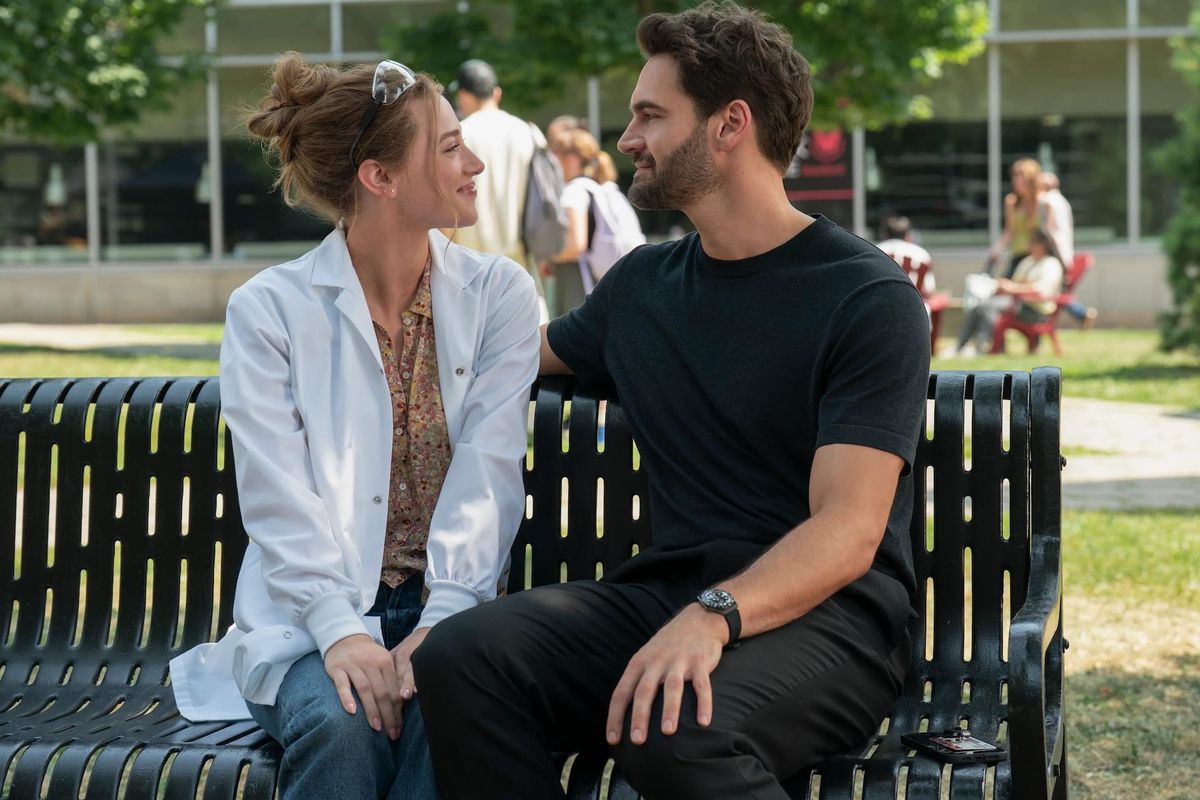
Unfortunately, the movie falters with casting Bateman as Carlsen. It’s not that Bateman is a bad actor; the problem is that he’s too conventionally handsome. There are, of course, ways to diminish his handsomeness, but The Love Hypothesis doesn’t bother. Instead, they’ve taken a hunk who clearly spends more time in the gym than the lab and thrown a white coat on him. Bateman tries to convince us that this guy would still be off-putting because he’s rude and could be on the spectrum (his delivery is somewhere between Mr. Spock and Laurie Bream from Silicon Valley), but while we can buy the other cast members as science grad students, he can’t overcome his debonair good looks. It’s as if the film prioritized making him eye candy rather than finding the balance between attractive and someone who would reasonably exist in this world.
The movie also doesn’t really know what to do with “science.” I never look to Hollywood for scientific accuracy (and if you do, you sometimes get rather dull movies), but some specificity goes a long way in investing you in the world of the characters. If they’re excited about certain things, then the audience will be too. However, there’s not much care in understanding even the particular branch of science these characters practice. In one scene, the grad students, one “Team Drunk” and the other “Team High,” are tasked with building a Rube Goldberg machine. But Rube Goldberg machines are physics, and these are chemists. Was it impossible to have a visually exciting montage using chemistry rather than physics? This may seem like a minor qualm, but it’s indicative of how The Love Hypothesis is rough around the edges in ways it doesn’t need to be. If anything, the formulaic nature of the plot is supposed to give you the space to refine the details since the core structure is so reliable.
That also carries over to the ending, which feels needlessly rushed. Plotlines are quickly wrapped up, characters like gay friend Malcolm (Jaboukie Young-White) are essentially hand-waved away, and Olive’s control over her life is ceded to other characters. For a movie that’s almost two hours, Scanlon should assume she either has the audience or she doesn’t, and there’s no need to speed to the end, especially at points where it diminishes Olive’s agency and accomplishments. Like with the depiction of Adam or the way the film handles science, these aren’t fatal flaws, but they speak to a larger clumsiness in what’s a straightforward romance yarn.
Thankfully, the clumsiness doesn’t sink the movie as much as it shows how much stronger it could have been. As it stands, it’s still a serviceable romance film, and its R-rating demonstrates Prime’s commitment to understanding that these are for fans of the novels, not the fluffy rom-coms of yesteryear. The sex scene is quite sexy, and Reinhart and Bateman have solid if unremarkable chemistry. But as more romance adaptations enter the marketplace, filmmakers will need to up their game. Not everything can be a Heated Rivalry, but it’s no longer enough to have warmed-over romance.
The Love Hypothesis arrives on Prime Video on September 23.